
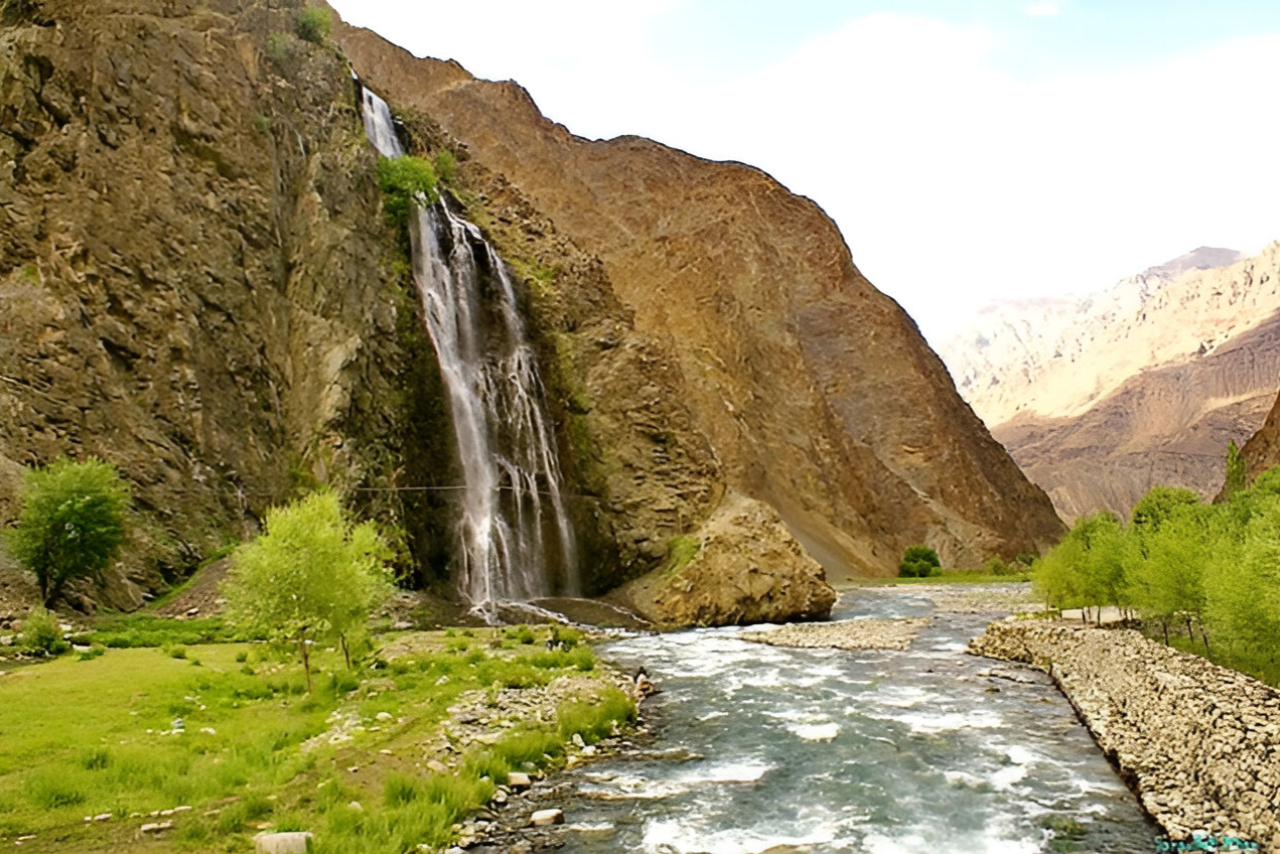
Manthokha Waterfall is an 180-foot cascade in Kharmang Valley, about 80 km from Skardu city and roughly 715 km from Islamabad, fed year-round by Karakoram glacial meltwater. It’s one of the tallest and most accessible waterfalls in Gilgit-Baltistan — reachable by sedan in dry conditions, with a small entry fee, seasonal trout restaurants, and a short walking trail from the parking area. This guide covers the exact route, current pricing, weather by month, and how to fit it into a Skardu itinerary.
Last updated: August 2026.
Quick Facts: Manthokha Waterfall
| Location | Kharmang Valley, near Madhupur village, Skardu District, Gilgit-Baltistan |
| Coordinates | 35.06°N, 75.92°E |
| Height | ~180 ft (55 m) |
| Distance from Skardu | ~80 km (63–103 km depending on starting point in Skardu) |
| Distance from Islamabad | ~715–730 km by road; ~1 hr flight to Skardu + 2.5–3.5 hr drive |
| Entry Fee | ~PKR 300 (Pakistani nationals) / PKR 700–1,000 (foreign nationals)* |
| Best Time to Visit | May–October (peak flow: June–August) |
| Nearest Airport | Skardu Airport |
| Drive Time from Skardu | 2.5–3.5 hours depending on vehicle |
*Entry fee is based on visitor-reported figures from local operators, not an official published rate — confirm on arrival. Have questions about current road status or want a driver arranged from Skardu? WhatsApp our Skardu-based team.
Where Is Manthokha Waterfall Located?
Manthokha Waterfall is located in Kharmang Valley, Gilgit-Baltistan, next to Madhupur village in Skardu District, at roughly 35.06°N, 75.92°E. The waterfall sits beside the Manthokha Nala, a stream that empties into the Indus River just below the falls. Kharmang Valley lies southeast of Skardu city along the Skardu–Kargil Road, in terrain of rocky cliffs, green pastures, and small Balti settlements strung along the Indus.
Manthokha village itself is the last real settlement before the site, and it doubles as a jumping-off point for travelers continuing further into Kharmang district toward Tolti. Because the waterfall sits so close to the main road, it’s one of the more accessible natural landmarks in this part of Gilgit-Baltistan — no trekking permit or multi-day approach required, just a paved highway and a short side road.
If you’re basing your trip out of Skardu Valley, Manthokha is a natural add-on to a Kharmang-focused day, and it sits inside the broader Kharmang Valley region Northern Discover covers in more depth separately.
How Far Is Manthokha Waterfall From Skardu?
Manthokha Waterfall lies approximately 80 km from Skardu city center via the Skardu–Kargil Road — the figure most commonly cited by Wikipedia, Gilgit-Baltistan’s tourism department, and most local operators. Plan around this number for a full city-to-waterfall round trip.
You’ll also see 40 km, 63 km, 72 km, and even 120 km quoted for the same trip elsewhere online. That’s not really a contradiction — it’s a measurement problem. Distance to Manthokha depends heavily on exactly where in Skardu you start:
| Starting Point in Skardu | Distance to Manthokha Waterfall |
| Royal Brangsa Guest House | ~63 km |
| Himalaya Hotel Skardu | ~72 km |
| Skardu city center (typical reference point) | ~80 km |
| Kharmang district boundary (regional distance, not the waterfall itself) | ~120 km |
The 63 km and 72 km figures come directly from our own Skardu hotel listings, which shows how much the starting point matters on this route. For trip planning, use 80 km / 2.5–3.5 hours as your baseline, and adjust down slightly if your hotel sits on the southeast side of town.
| From Skardu To | Approx. Distance |
| Manthokha Waterfall | ~80 km (50 mi) |
| Shigar Valley | ~32 km (20 mi) |
| Khaplu | ~103 km (64 mi) |
| Deosai Plains (Chota Deosai entry) | ~30 km (19 mi) |
Manthokha sits farther from Skardu than Shigar but closer than Khaplu, placing it in the mid-range for day-trip planning from the city.
How Long Does the Drive Take?
| Vehicle Type | Approx. Travel Time | Road Condition Notes |
| Sedan / saloon car | 3 – 3.5 hours | Manageable on paved sections; slower on the final approach road |
| 4×4 / jeep | 2.5 – 3 hours | Handles unpaved and uneven stretches near Manthokha village with less strain |
| Local minivan / Hiace | 3 – 3.5 hours | Common for group tours; similar pace to sedans |
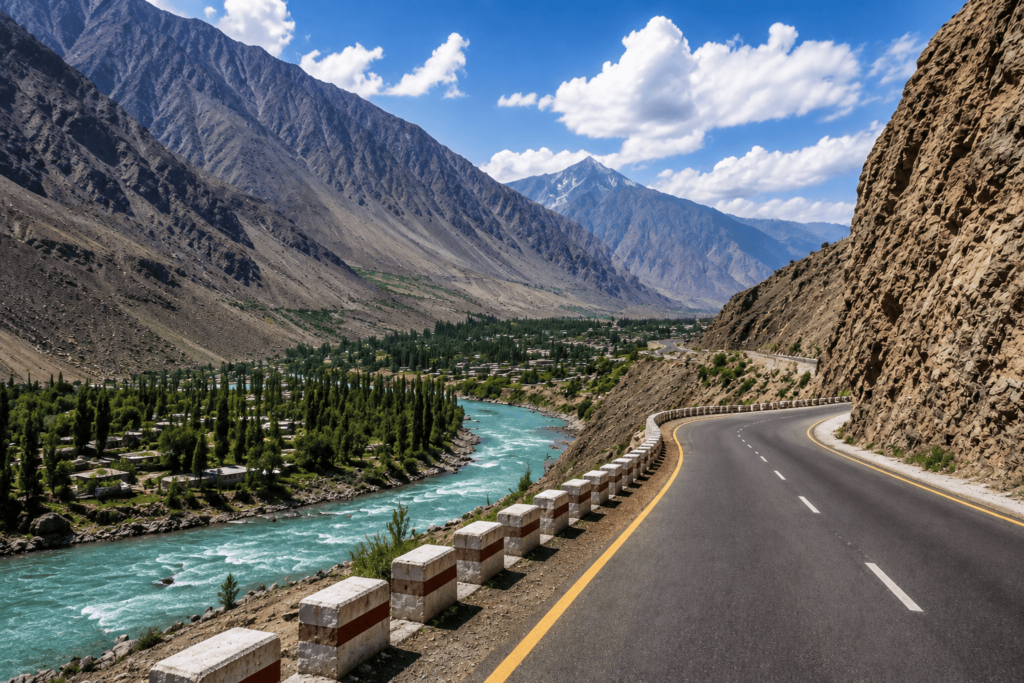
The final approach road from Madhupur can develop washboard surfaces after heavy rain, making speeds slower than on the main Skardu–Kargil Road. If you don’t have your own transport, you can rent a car in Skardu with a local driver who knows the turns and road conditions along the Indus.
How to Reach Manthokha Waterfall (Route Guide)
- Start from Skardu Bazar and head southeast on the Skardu–Kargil Road, following the Indus River.
- Pass through Hussainabad village, roughly 15–20 km outside Skardu city.
- Continue through Thorgo village, where small fuel and tea stops are available.
- Drive through Parkutta, a larger village with basic shops and fuel availability.
- Pass Ghasing village, where the road begins to narrow slightly.
- Reach Manthokha village, the main settlement before the waterfall turnoff.
- Turn onto the Madhupur–Manthokha link road, on the east side of the Manthokha Nala stream.
- Follow this side road for approximately 5–6 km until you reach the waterfall site.
- Park at the designated area near the base and walk the short remaining distance on foot.
Fuel stops are most reliable in Parkutta and Thorgo; fill up before leaving Skardu if traveling early morning, since smaller villages may not have fuel available at all hours.
Can a Sedan Reach the Waterfall?
Yes, a standard sedan can reach Manthokha Waterfall under normal conditions. The Skardu–Kargil Road is paved for the majority of the route, making it suitable for non-4×4 vehicles. The final 5–6 km stretch from Madhupur to the waterfall is narrower and less consistently maintained, which can be uncomfortable in a low-clearance car. During or after rain, this final stretch can become slippery, and a 4×4 is the safer option. For most dry-season visits, a careful sedan driver won’t need to switch vehicles.
How Far Is Manthokha Waterfall From Islamabad?
By road, Manthokha Waterfall is roughly 715–730 km from Islamabad — about 635–650 km to Skardu via the Karakoram Highway, plus another 80 km on to the waterfall. There’s no route that skips Skardu; every road option funnels through the city first.
Route: Islamabad → Abbottabad → Mansehra → Besham → Dasu → Chilas → Skardu (Karakoram Highway / N-35, then the S-1 Skardu Road) → Manthokha Waterfall via the Skardu–Kargil Road.
Realistic driving time is 19–24 hours door-to-door, and almost nobody does this in one push. Most travelers break the Islamabad–Skardu leg with an overnight stop before continuing on to Kharmang the next day. For the full breakdown of the Islamabad–Skardu leg — fuel stops, road conditions, and timing — see our Islamabad to Skardu Distance guide.
By air, the trip is far more practical: PIA and Airblue fly Islamabad–Skardu in about 1 hour to 1 hour 15 minutes, weather permitting, followed by a 2.5–3.5 hour drive to Manthokha. This makes a Manthokha day trip realistic even on a short Skardu visit — flights are morning-only and occasionally cancelled by weather, so build at least one buffer day into your itinerary if you’re flying in specifically for this.
Height and Natural Features of Manthokha Waterfall
Manthokha Waterfall is approximately 180 feet (55 meters) high, making it one of the taller waterfalls in Gilgit-Baltistan. The water drops over a rocky cliff face fed by the Manthokha Nala stream, which eventually joins the Indus River.
The waterfall is multi-tiered, with water breaking across rock ledges rather than falling in a single uninterrupted sheet. Green pastures and farmland surround the base, contrasting with the bare rock slopes above. Rocky outcrops from the Karakoram foothills frame the falls on both sides, and mist reaches the nearby walking path during high-flow months.
Manthokha Waterfall Weather & Best Time to Visit
The best time to visit Manthokha Waterfall is May through October, when the Skardu–Kargil Road stays reliably open and glacial meltwater keeps the falls running at full strength. Peak flow lands in June, July, and August.
Manthokha doesn’t have its own weather station — the closest reliable data comes from Skardu, about 80 km up the valley. Kharmang sits at a lower elevation along the Indus, so daytime temperatures at the waterfall typically run a little milder than Skardu city, especially in winter.
Seasonal Weather & Experience Comparison
| Season | Skardu-Area Daytime Temp (approx.) | Waterfall Flow | Road Condition |
| Spring (Mar–May) | 5°C to 15°C | Rising, fed by early snowmelt | Generally passable, occasional mud |
| Summer (Jun–Aug) | 20°C to 23°C | Peak flow, strongest mist | Fully open, best driving conditions |
| Autumn (Sep–Oct) | 14°C to 18°C | Gradually decreasing | Open, stable |
| Winter (Nov–Feb) | -3°C to 5°C (colder at night) | Reduced, partially icy | Variable, risk of snow blockage |
Figures are regional Skardu averages used as the nearest reference point for Kharmang Valley. Summer delivers the fullest waterfall volume and the most reliable road access. Autumn offers calmer crowds with a different color palette across the valley. Winter brings the weakest flow and the most uncertain access of the four seasons. For a full month-by-month breakdown of Skardu’s climate, see our Best Month to Visit Skardu guide.
Is Manthokha Waterfall Accessible in Winter?
Winter access to Manthokha Waterfall is possible but not guaranteed. Snowfall on the Skardu–Kargil Road, especially the unpaved stretch near Madhupur, can slow or close the final approach. Cold temperatures also cut the waterfall’s flow, and some roadside stalls close for the season.
If you’re visiting outside May–October, check current road status with a local driver or transport service before leaving Skardu, and prefer a 4×4 over a sedan if snow has fallen recently.
Manthokha Waterfall Entry Fee & Cost Breakdown
Manthokha Waterfall charges a small entry fee, commonly reported at around PKR 300 for Pakistani nationals and PKR 700–1,000 for foreign nationals. These figures come from local operators and visitor reports rather than a published rate card — Northern Discover hasn’t independently verified the current amount with site management, so treat it as a planning estimate and confirm on arrival.
| Expense | Approx. Cost (PKR) | Notes |
| Entry fee | 300 (domestic) / 700–1,000 (foreign) | Visitor-reported; confirm locally |
| Private car hire (round trip from Skardu) | 6,000 – 9,000 | Varies by vehicle type and driver negotiation |
| Fuel estimate (sedan, round trip) | 3,000 – 4,500 | Based on ~160 km round trip |
| Organized tour package (per person) | 2,500 – 4,000 | Often bundled with Kharmang Valley sightseeing |
| Food (roadside meal, per person) | 500 – 1,000 | Tea stalls and small eateries en route |
| Overnight at the waterfall (resort chalet) | 30,000 – 40,000 / night | See “Where to Stay” below; confirm current rates directly |
All figures are approximate as of August 2026 and should be confirmed locally before booking, as fuel, transport, and accommodation prices in Gilgit-Baltistan fluctuate seasonally.
Can You Visit as a Day Trip From Skardu?
Manthokha Waterfall can comfortably be visited as a day trip from Skardu. With a round-trip drive of roughly 6–7 hours and 1–2 hours at the site, the full outing fits within a single day.
Leaving Skardu by 7–8 AM allows enough time to reach the waterfall, explore the area, eat a roadside meal, and return before evening. Travelers combining Manthokha with additional stops in Kharmang Valley should budget extra time or consider an overnight stay instead. For a standalone visit, a single day is sufficient without rushing.
Suggested Itineraries
Half-Day Plan (Manthokha Focus):
- Depart Skardu by 7:30 AM via the Skardu–Kargil Road.
- Arrive at Manthokha Waterfall by approximately 11:00 AM.
- Spend 1–1.5 hours walking the base area and taking photographs.
- Eat lunch at a roadside stall near Manthokha or Parkutta village.
- Return to Skardu by mid-to-late afternoon.
Full-Day Plan (Manthokha + Kharmang Valley):
- Depart Skardu by 7:00 AM.
- Stop briefly in Parkutta for tea and a short break.
- Reach Manthokha Waterfall by late morning and explore for 1.5 hours.
- Continue into Kharmang Valley for additional sightseeing along the Indus.
- Visit a viewpoint or village stop before heading back toward Skardu.
- Return to Skardu by evening.
Kharmang Valley Circuit:
- Combine Manthokha Waterfall with stops at Khaplu-direction villages along the same road corridor.
- Mobile coverage becomes less reliable beyond Parkutta, so download offline maps in Skardu before departure.
- Allow a full day, or consider one overnight stay for a more relaxed pace.
Skardu Family Tour Route:
- Pair Manthokha Waterfall with a Shigar Valley visit on a separate day for families wanting varied scenery.
- Keep Manthokha as a single-focus day given the drive length, especially with young children.
- Plan rest stops in Thorgo or Parkutta to break up the journey.
Nearby Attractions to Combine With Your Visit
- Kharmang Valley — the broader valley region surrounding Manthokha, known for orchards and Balti village life.
- Blind Lake — a notable nearby water feature often included in Kharmang-area itineraries.
- Indus River viewpoints — multiple roadside points along the Skardu–Kargil Road offer river views during the drive.
- Parkutta and Thorgo villages — practical stops for food, tea, and a glimpse of local daily life along the route.
- Madhupur village — the settlement closest to the waterfall turnoff, useful as a landmark for navigation.
Local Expert Tips for Visiting
- Best photo spots: the base viewing area directly facing the falls, and the rocky ledge slightly above it for a wider angle of the full drop.
- Best visiting hours: mid-morning to early afternoon, when light is strongest and mist from the falls is most visible.
- Crowd avoidance: visit on weekdays rather than weekends, when local and domestic tourist groups are more frequent.
- Mobile network coverage: signal is inconsistent past Parkutta and largely unreliable near the waterfall itself; download offline maps from maps.me in Skardu beforehand.
- Washroom availability: limited; basic facilities may exist at roadside stalls, but don’t expect formal restrooms at the site.
- Food availability: small stalls near Manthokha village serve tea, eggs, and simple meals; trout dishes are available at a few nearby eateries.
- Family safety: the walking path near the base can be slippery from spray; supervise children closely near the water’s edge.
Where to Stay Near Manthokha Waterfall
Most visitors base themselves in Skardu and treat Manthokha as a day trip, but a resort now operates directly at the waterfall for travelers who want to stay overnight.
- Manthokha Waterfall Resort — chalet-style accommodation on site in Kharmang Valley, with airport transfer available from Skardu. Nightly rates are commonly listed in the PKR 30,000–40,000 range; confirm current pricing and availability directly before booking, as small on-site properties in this area can change seasonally.
- Roadside eateries in Manthokha village — tea stalls and small restaurants serving eggs, simple meals, and locally farmed trout; a common lunch stop for day-trippers and resort guests alike.
- Skardu-based hotels — for travelers who prefer to stay in the city and drive out, options such as Royal Brangsa Guest House (~63 km from the falls) and Himalaya Hotel Skardu (~72 km) put you closer to Manthokha than most Skardu-city accommodation.
Brief History and Local Background
Manthokha Waterfall takes its name from Manthokha village, the settlement closest to its base in Kharmang Valley. The waterfall is fed by the Manthokha Nala, a stream that descends from the surrounding mountains before joining the Indus River. The site has long served as a local gathering point for nearby Balti communities, with fishing and small-scale farming forming part of daily life in the area.
Its proximity to the Skardu–Kargil Road has gradually made it a recognized stop for travelers passing through the valley, and national coverage of Skardu’s tourism boom — including in outlets like Dawn — has increasingly featured Manthokha as one of the region’s signature side-trips, alongside its role as a local landmark for residents of Kharmang district.
FAQs
Where exactly is Manthokha Waterfall located?
Manthokha Waterfall is located in Kharmang Valley, near Madhupur village, in Skardu district, Gilgit-Baltistan.
How far is Manthokha Waterfall from Skardu city?
It lies approximately 80 km (50 miles) from Skardu city center, though real distances from specific hotels in Skardu range from about 63 km to 103 km depending on your exact starting point.
How far is Manthokha Waterfall from Skardu?
It is roughly 80 km from Skardu city center, taking around 2.5 to 3.5 hours by road.
Can you visit Manthokha Waterfall in winter?
Yes, but flow is reduced, roads can be icy near Madhupur, and 4×4 vehicles are recommended after snowfall.
How far is Manthokha Waterfall from Islamabad?
By road, it’s roughly 715–730 km — about 635–650 km to Skardu via the Karakoram Highway, plus another 80 km on to the waterfall. By air, it’s a 1 hour to 1 hour 15 minute flight to Skardu, followed by a 2.5–3.5 hour drive.
How long does the drive from Skardu take?
The drive from Skardu to Manthokha Waterfall typically takes 3 to 3.5 hours by sedan, or 2.5 to 3 hours by 4×4, depending on road conditions.
Is Manthokha Waterfall worth visiting?
Yes — for travelers interested in a scenic drive along the Indus and a tall, accessible waterfall, it’s a worthwhile stop in the Kharmang area.
What is the height of Manthokha Waterfall?
The waterfall is approximately 180 feet (55 meters) high.
Can I visit Manthokha Waterfall in a normal car or sedan?
Yes, a sedan can reach the site under normal dry conditions, though the final 5–6 km stretch is narrower and less maintained.
What is the entry fee for Manthokha Waterfall?
Entry is approximately PKR 300 for domestic travelers and PKR 700–1,000 for foreign visitors [PH_VERIFY: confirm official current rate].
What’s the best time of year to visit, and what’s the weather like?
May through October, with peak flow in June–August. Winters are cold (Skardu-area daytime highs of roughly -3°C to 5°C) with reduced, sometimes partially icy, flow.
Is Manthokha Waterfall accessible in winter?
Winter access is possible but conditional on snowfall and road status; it’s not guaranteed.
Can Manthokha Waterfall be combined with other Skardu attractions in one trip?
Yes, it’s commonly paired with Kharmang Valley sightseeing and Blind Lake on the same route.
Is there anywhere to stay right at the waterfall?
Yes — Manthokha Waterfall Resort operates chalet-style rooms on site, typically PKR 30,000–40,000 per night. Most travelers still base themselves in Skardu and visit as a day trip.
Are there restaurants or washrooms near the waterfall?
Basic roadside stalls offer food and tea; formal washroom facilities are limited.
Is the area safe for families and children?
Generally yes, though supervision is recommended near the wet, slippery base area close to the water.
Written by Hassan Sulaimani — Northern Pakistan Travel Specialist, based in Skardu. View all posts
Plan Your Manthokha Waterfall Trip
Whether you want a driver arranged from Skardu, a full Kharmang Valley day, or a custom itinerary built around this waterfall, our Skardu-based team can put it together.
Or email us at northerndiscover.pk@gmail.com