
Fairy Meadows Travel Guide 2026: Route, Costs, Safety & Where to Stay
Diamer District · Gilgit-Baltistan · Updated August 2026
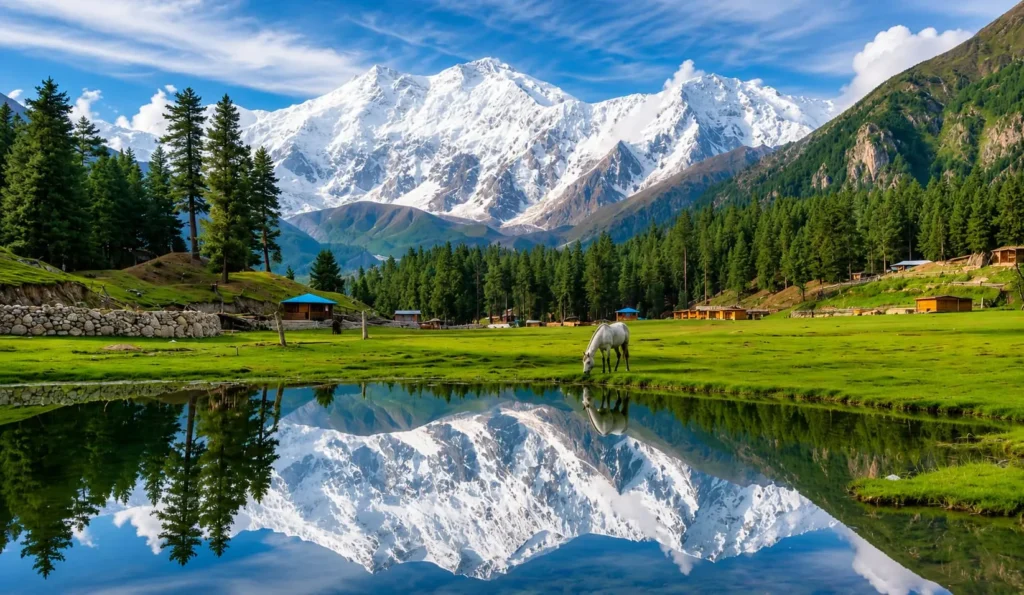
Everything you need before you book the jeep — real 2026 fares, the current road situation, honest lodging comparisons, and the one fact almost no guide gets right about the view.
By Hassan Sulaimani — Founder, Northern Discover, with ground insights from Shahid Hashmi and ND’s local guides in Gilgit-Baltistan
What’s in This Guide
- Fairy Meadows at a Glance
- Is Fairy Meadows Worth Visiting in 2026?
- Where Is Fairy Meadows — and What Are You Actually Looking At?
- How to Reach Fairy Meadows: Step-by-Step
- The Raikot–Tattu Jeep Road: Costs, Safety & the 2026 Situation
- Best Time to Visit Fairy Meadows
- Where to Stay: Fairy Meadows vs Beyal Camp
- Trekking Beyond: Beyal Camp & Nanga Parbat Base Camp
- Fairy Meadows at Night
- Fairy Meadows vs Hunza vs Skardu
- 2026 Costs at a Glance
- Safety, Permits & Trail Etiquette
- Responsible Travel
- Packing Checklist
- FAQs
Fairy Meadows at a Glance
Fairy Meadows sits at 3,300 m in Diamer District, Gilgit-Baltistan, directly below Nanga Parbat’s north face — reachable by jeep and a short trek, with no technical climbing required. Locally it’s known as Joot. Here’s the quick reference before you plan around it.
| Detail | Info |
|---|---|
| Location | Diamer District, Gilgit-Baltistan (near Chilas) |
| Elevation | ~3,300 m (10,800 ft) |
| Coordinates | 35.387°N, 74.584°E (approx.) |
| Nearest airport | Gilgit (1 hr flight from Islamabad, weather-dependent) |
| Access route | Karakoram Highway → Raikot Bridge → jeep to Tattu → trek |
| Jeep fare (2026) | PKR 16,000–20,000 round trip, per full jeep (5–6 people) |
| Open season | ~May to late October (snow-closed the rest of the year) |
| Best months | Late May–June and September–October |
| National park status | Declared 1995; now part of Nanga Parbat National Park (since 2021) |
Is Fairy Meadows Worth Visiting in 2026?
Yes — Fairy Meadows is worth it if you want one of the closest, easiest alpine views of an 8,000-metre peak anywhere in the world, without a multi-day technical trek. It’s a different kind of “worth it” than a place like Deosai or Rush Lake: the reward here is proximity to a genuinely massive mountain, reached in a single hard day of jeep and trekking rather than a week of expedition planning.
It’s worth tempering the enthusiasm, though. If you go in July or August expecting solitude, you’ll be disappointed — the main meadow gets crowded, lodges fill up, and prices rise. The people who leave unimpressed are almost always the ones who spent their whole trip at the busiest viewpoint on the busiest weekend of the year.
Why it’s worth it
- Nanga Parbat’s north face fills the skyline directly above the meadow
- One of the only accessible alpine meadows in the world at this elevation
- Optional extension to Beyal Camp or Nanga Parbat Base Camp for those who want more
- No technical climbing, glacier travel, or permits required for the meadow itself
Why some travelers leave disappointed
- July–August crowds at the main meadow and its viewpoints
- Peak-season lodge prices rise sharply with demand
- The main meadow has a commercial, café-lined feel that surprises people expecting untouched wilderness
ND Local Tip: Base yourself at Beyal Camp rather than the main meadow if quiet matters to you. It’s a 4–5 hour round-trip walk further in, and the Nanga Parbat view is arguably better and far less crowded.
If solitude is the main goal, pair Fairy Meadows with a genuinely quiet valley — Rush Lake or Haramosh Valley — for a trip that contrasts drama against silence rather than chasing both in one place.
Where Is Fairy Meadows — and What Are You Actually Looking At?
Fairy Meadows lies in the Rakhiot Valley of Diamer District, on the northern flank of Nanga Parbat, the world’s ninth-highest mountain at 8,126 m. It was named by German climbers during the Nanga Parbat expeditions of the 1930s — Märchenwiese, or “fairy tale meadows” — for the almost storybook contrast of green pasture directly beneath permanent ice. Locally, it has always been known simply as Joot.
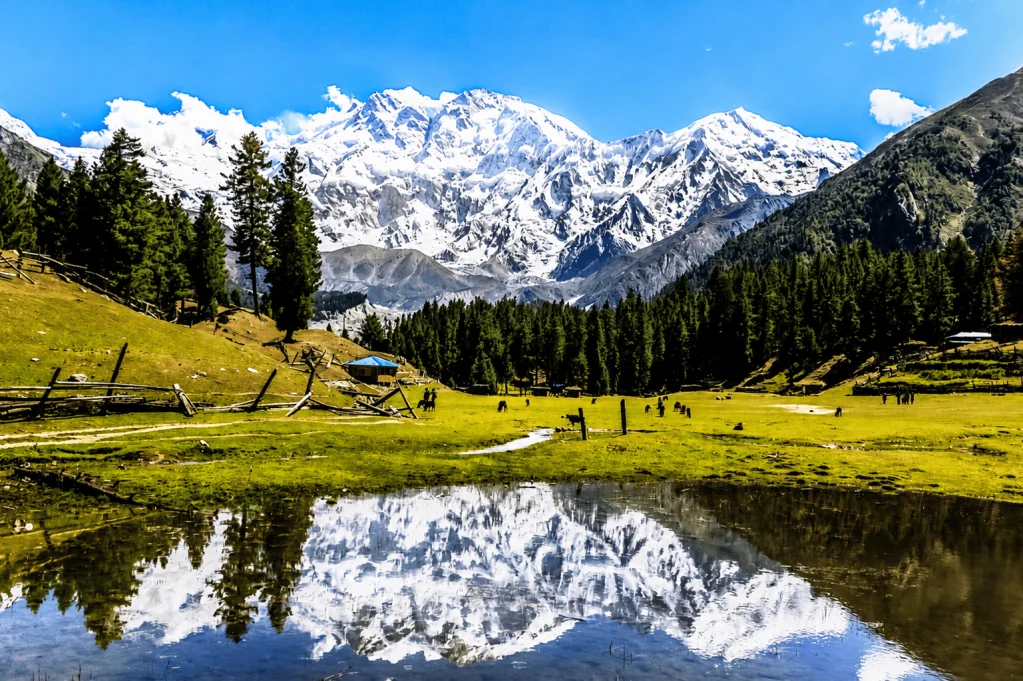
Here’s the detail almost no travel guide mentions: the huge, close peak you photograph from Fairy Meadows is not Nanga Parbat’s summit. It’s the North Peak, at 7,816 m. The true summit, 8,126 m, stays hidden behind the North Peak’s massif and the Silver Saddle from this angle — you’d need to trek higher, toward Nanga Parbat Base Camp, to get a partial line on it. It doesn’t make the view any less staggering. It just means the mountain you’re standing under is even bigger than it looks.
Fairy Meadows became a Pakistan National Park in 1995 and today sits within the wider Nanga Parbat National Park. The area is genuinely wild beyond the lodges — brown bear, musk deer, Himalayan ibex, and markhor all range through the surrounding forest, and the Raikot Glacier above the meadow feeds a stream that eventually joins the Indus.
How to Reach Fairy Meadows: Step-by-Step (2026)
Step 1 — Get to Gilgit or Chilas
- Flight: Islamabad → Gilgit, about 1 hour, PIA, weather-dependent — mountain visibility and wind can cause cancellations, so build in a buffer day
- Road via KKH (all vehicles, fully paved): Islamabad → Abbottabad → Besham → Chilas → Raikot Bridge, roughly 490 km, 12–15 hours
- Road via Babusar Pass (scenic, seasonal): Islamabad → Naran → Babusar Top (4,173 m) → Chilas → Raikot Bridge, roughly 410 km, 10–12 hours — closed through winter and early spring, and entirely weather-dependent even in season
Step 2 — Reach Raikot Bridge
Raikot Bridge sits on the Karakoram Highway roughly 76–80 km from Gilgit, about 2–3 hours by road. This is where the paved highway ends and the jeep track begins.
Step 3 — Jeep to Tattu Village
- Distance: 15–16 km of narrow, unpaved cliff track
- Duration: 1.5–2.5 hours
- Cost: PKR 16,000–20,000 round trip per full jeep (5–6 passengers), 2026 union rates
- Vehicle: only union-registered local 4×4 jeeps are permitted on this road — you cannot drive your own vehicle up it
Safety habit worth keeping: photograph the jeep’s number plate and the driver’s ID before you set off. It’s standard practice locally, costs nothing, and matters if anything needs following up afterward.
Step 4 — Trek to Fairy Meadows
- Distance: 3–5 km through forest, moderately steep
- Duration: 2–4 hours depending on pace and fitness
- Horses: available for those who need them — roughly PKR 3,500 one-way uphill, PKR 1,500 one-way down, or PKR 5,000 fixed round trip per horse
Critical trail rule: when a horse or mule train passes you on the trail, stand on the mountain side — never the cliff side.
From Lahore
Roughly 700–780 km, 17–20 hours by road. The practical route is Lahore → Islamabad → KKH → Chilas → Raikot Bridge; most Lahore-based travelers split this into two driving days or fly Lahore–Islamabad–Gilgit to cut travel time significantly.
The Raikot–Tattu Jeep Road: Costs, Safety & the 2026 Situation
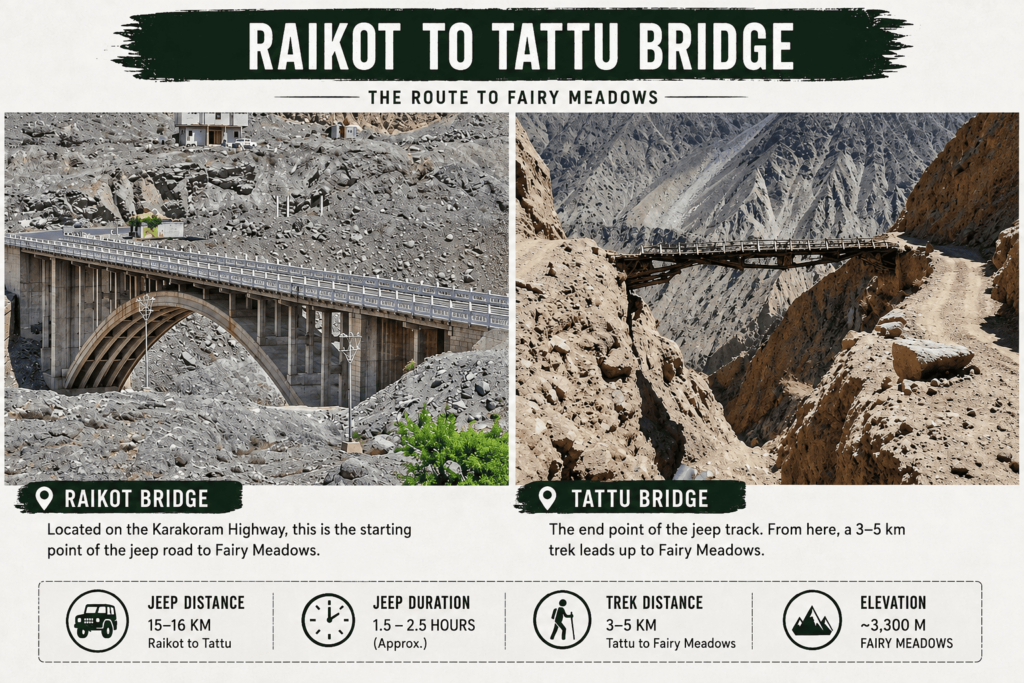
The jeep track has a fearsome reputation, and it’s earned honestly: the World Health Organization named it the world’s second-deadliest road in 2013. That reputation, and the reality, are two different things — thousands of travelers complete this road safely every season, in union-registered jeeps driven by people who know every metre of it.
What we won’t do is tell you it’s simply “safe” and leave it there. In 2026, this specific road saw a serious jeep accident that led to a temporary administrative ban on vehicle movement while the situation was assessed, alongside normal monsoon-season landslide and glacier-related closures on the wetter months. None of this means don’t go — it means don’t treat any guide’s “it’s fine” as gospel for your specific travel dates.
- Confirm current road status with Gilgit-Baltistan tourism authorities or a local operator close to your travel dates — not a package page that hasn’t been updated in months
- Build a buffer day into your itinerary on both ends, especially if you’re flying into Gilgit
- Confirm your jeep and driver are union-registered — this is the actual safety standard on this specific road, not a formality
- Check that your travel insurance covers evacuation and delay, not just medical costs
Money transparency on the jeep and lodges
- Confirm upfront whether a quoted price is per jeep or per person
- Ask for a receipt or a photo confirmation of the agreed fare
- Avoid unregistered jeeps, even if the price looks better
- Carry small bills — change is often limited at Raikot and Tattu
On comfort: avoid a heavy meal right before the ride, let the driver guide where you sit for weight balance, and bring motion-sickness tablets if you’re prone to it. It’s bumpy and it’s cliff-edge — that’s the honest description, not an exaggeration.
Best Time to Visit Fairy Meadows
Late May through early October is the realistic visiting window — the jeep track itself is normally snow-closed from late October until April or May. Inside that window, when you go changes the experience more than most guides admit.
| Season | What to expect |
|---|---|
| Peak (June–August) | Full services, green meadows, warm days — but crowded and pricier |
| Shoulder (late May–June, September–October) | Best light for photography, fewer crowds, cold nights — the local favorite window |
| Closed (late October–April/May) | Jeep road snow-closed; only accessible to experienced winter trekkers, and lodges are largely shut |
ND seasonal advice: aim for late May to early June, or September into early October, for the best balance of clear skies, manageable crowds, and a Nanga Parbat view that isn’t shared with fifty other people at the same viewpoint. Related: Best Time to Visit Gilgit-Baltistan.
Where to Stay: Fairy Meadows vs Beyal Camp
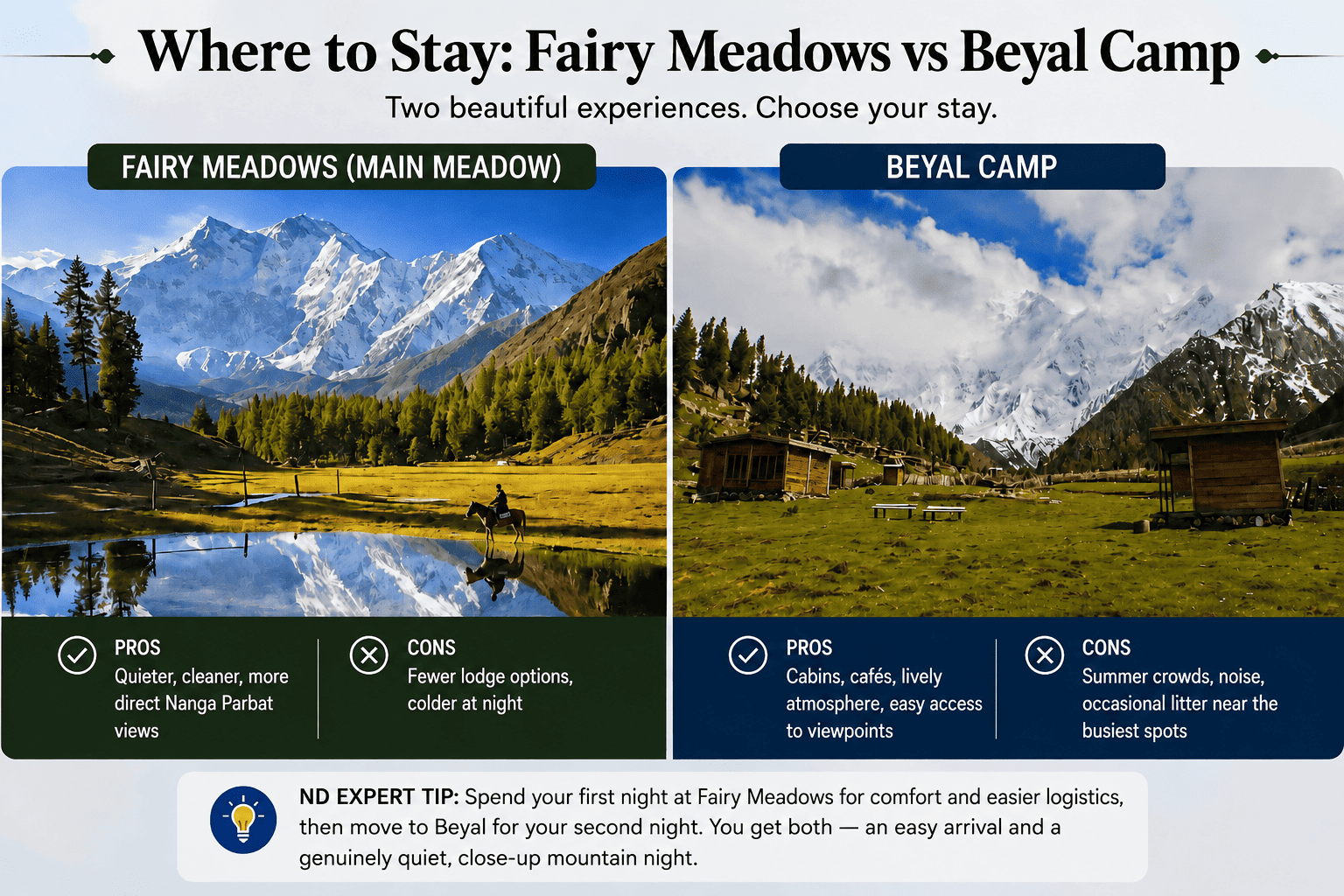
ND Expert Tip: spend your first night at Fairy Meadows for comfort and easier logistics, then move to Beyal for your second night. You get both — an easy arrival and a genuinely quiet, close-up mountain night.
| Fairy Meadows (Main Meadow) | Beyal Camp | |
|---|---|---|
| Pros | Cabins, cafés, lively atmosphere, easy access to viewpoints | Quieter, cleaner, more direct Nanga Parbat views |
| Cons | Summer crowds, noise, occasional litter near the busiest spots | Fewer lodge options, colder at night |
Fairy Meadows lodges (2026)
- Raikot Serai (Sarai) — the most established property on the meadow; wooden cabins, in-house dining, good for families and groups
- Fairy Meadows Cottages — near the main meadow, known for strong sunrise viewpoints, popular with couples and photographers
- Broad View Hotel & Resort — heated timber cabins with attached bathrooms, breakfast and dinner included, popular with international guests
- Greenland Resort — budget-friendly wooden huts, basic but clean, favored by trekkers on tighter budgets
- North Face Resort — positioned for direct views of Nanga Parbat’s north face
Expect to pay roughly PKR 4,000–12,000 per night at locally run lodges, or the equivalent of USD 50–110 per night at international-facing cabins that include breakfast and dinner. Rates rise sharply during the July and August peak season, so contact properties early to confirm exact seasonal pricing and hold your room.
At Beyal, accommodation is simpler — a handful of local guest houses and camps rather than named resort brands. It’s the trade-off for the quiet: fewer choices, but arguably the best sunrise and Milky Way views in the whole valley.
Trekking Beyond Fairy Meadows: Beyal Camp & Nanga Parbat Base Camp
| Point | Elevation |
|---|---|
| Fairy Meadows | ~3,300 m |
| Beyal Camp | ~3,500 m |
| Nanga Parbat Base Camp | ~4,000–4,100 m |
Suggested 3-day rhythm
- Day 1: Arrive at Fairy Meadows, acclimatize, easy walk to Reflection Point
- Day 2: Trek to Beyal Camp (4–5 hours return through pine forest and meadow, easy gradient), overnight
- Day 3: Full-day push to Nanga Parbat Base Camp (8–10 hours round trip from Beyal), return to Beyal or back down to Fairy Meadows
Mountain weather here shifts fast. Avoid pushing toward Base Camp in active rain or snow — this is where most avoidable trekking incidents actually happen, not on the jeep road.
Fairy Meadows at Night: Stars, Milky Way & the Glacier Glow
At 3,300 m with almost no light pollution, Fairy Meadows is one of Pakistan’s best natural observatories. On a clear night the Milky Way stretches across the whole meadow as a visible band, and Nanga Parbat’s north face takes on a pale, silver-blue glow under moonlight — what photographers here call the glacier glow.
The best viewing spots are the Reflection Pond, Beyal Camp, and the ridge above the main meadow. Aim for late May–June or September–October for the clearest, driest skies, and avoid the wetter parts of the monsoon window if stargazing is a priority.
Fairy Meadows vs Hunza vs Skardu

2026 Costs at a Glance
| Item | Typical 2026 cost |
|---|---|
| Jeep, Raikot Bridge ↔ Tattu (round trip, per jeep, up to 6 pax) | PKR 16,000–20,000 |
| Horse, one-way up | ~PKR 3,500 |
| Horse, one-way down | ~PKR 1,500 |
| Local lodge, per night | PKR 4,000–12,000 |
| International-facing cabin with meals, per night | ~USD 50–110 |
| Porter | PKR 1,500–3,000 per day |
Park Entry: There is currently no fixed park entry ticket fee charged specifically for Fairy Meadows itself (unlike Deosai National Park). However, local valley checkpost rules can update without notice, so double-check at Raikot Bridge before starting your climb.
How to avoid overpaying
- Ask two or three drivers for quotes before committing
- Pay locals fairly — undercutting hard doesn’t build the trust you want as a repeat visitor or a partner
- Book your jeep and lodge through a local operator to skip inflated walk-up tourist pricing
Safety, Permits & Trail Etiquette
Fairy Meadows sits well inside Gilgit-Baltistan’s open tourism zone — this is not an NOC-restricted area for the meadow itself, and it’s among the safer trekking regions in Pakistan. Most problems that do happen trace back to weather, poor preparation, or overconfidence on the jeep road — not security concerns.
- Register at the Raikot checkpoint as required
- Check jeep road conditions after any recent rainfall before departing
- Use a verified local guide if you want English-language support on the trail
Trail etiquette
- Stand toward the mountain, not the cliff edge, when horses or mules pass
- Yield to uphill trekkers
- Keep noise down — sound carries a long way in these valleys
- Buy chai or snacks from families in Tattu village — it’s a small, direct way to support the community you’re passing through
Responsible Travel: Fairy Meadows’ Litter Problem
Fairy Meadows’ popularity has come with a real cost: litter around the busiest viewpoints is a documented, ongoing problem, and it’s one that every visitor can help fix in five minutes a day.
- Carry a refillable water bottle instead of buying disposable ones
- Eat at family-run tea houses in Tattu and at the meadow rather than packaged snacks where possible
- Pack out everything you bring in
- Pick up at least one piece of litter a day — it’s a small habit that adds up across thousands of visitors a season
Packing Checklist
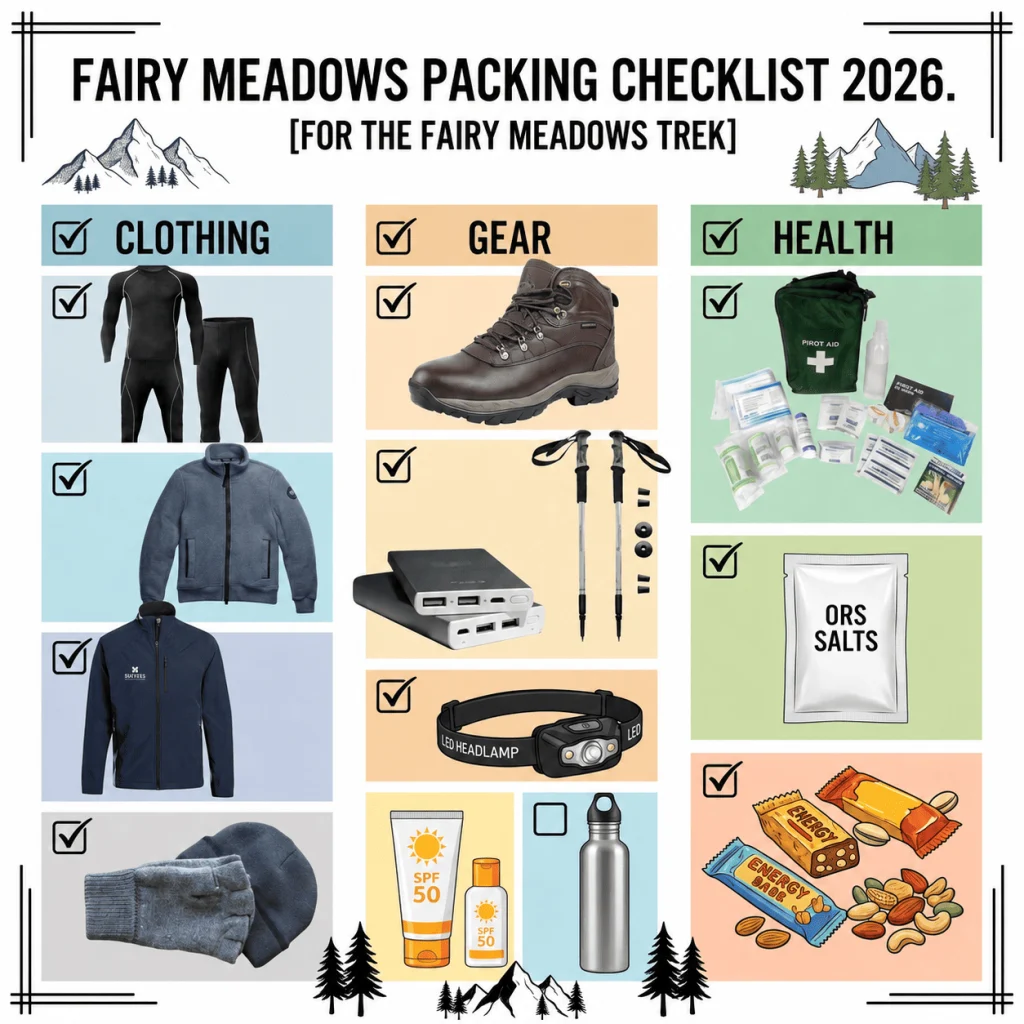
Clothing
- Base layers
- Fleece
- Waterproof shell
- Gloves and beanie
Gear
- Hiking boots
- Trekking poles
- Power bank
- Headlamp
- Sunscreen
- 1–2 L water bottle
Health
- Oral rehydration salts
- Light trail snacks
- Basic first-aid kit
Plan It With Northern Discover
We don’t yet have a dedicated Fairy Meadows tour package live — it’s on our build list. In the meantime, our Skardu-based team can put together a custom jeep, lodge, and guide plan for you directly over WhatsApp. If you’re comparing regions first, these are live now:
- Skardu Adventure Tour
- Deosai Jeep Safari
- Skardu Trip Cost Guide
Frequently Asked Questions
Where is Fairy Meadows located?
Fairy Meadows is in Diamer District, Gilgit-Baltistan, Pakistan, directly below the north face of Nanga Parbat. It sits at roughly 3,300 m and is reached via Raikot Bridge, a jeep ride to Tattu village, and a 2–4 hour trek.
Why is it called Fairy Meadows?
German climbers on 1930s Nanga Parbat expeditions named it Märchenwiese — “fairy tale meadows” — for its alpine beauty beneath the mountain. Locally, it’s known as Joot.
How do you reach Fairy Meadows?
Fly or drive to Gilgit or Chilas, reach Raikot Bridge on the Karakoram Highway, take a union-registered jeep 15–16 km to Tattu village, then trek 3–5 km (2–4 hours) up to the meadow.
Can you actually see Nanga Parbat’s summit from Fairy Meadows?
Not quite. The huge peak visible from the meadow is the North Peak (7,816 m), not the true summit (8,126 m), which stays hidden behind the North Peak’s massif and the Silver Saddle. The view is still one of the most dramatic in the country.
Is Fairy Meadows safe to visit?
It’s one of Pakistan’s safer trekking regions for security. The real risks are weather and road conditions on the jeep track — check current status close to your travel dates, register at the Raikot checkpoint, and use a union-registered jeep.
Is Fairy Meadows worth visiting?
Yes, for the alpine meadow and close-up Nanga Parbat view accessible without technical climbing. Visit outside July–August, or extend to Beyal Camp, for a quieter and more rewarding experience.
How long is the jeep ride, and what does it cost in 2026?
The jeep ride from Raikot Bridge to Tattu takes 1.5–2.5 hours and costs roughly PKR 16,000–20,000 round trip per full jeep, carrying up to 5–6 people. Fares are union-set and can rise in peak season.
What is the best time to visit Fairy Meadows?
Late May through early October, when the jeep track is open. June–August is warmest but busiest; late May–June and September–October offer better light and fewer crowds.
Is Hunza or Fairy Meadows the better trip?
It depends on what you want. Fairy Meadows is better for raw, close-up mountain trekking; Hunza offers more comfort, culture, and easier road access. Many travelers combine both on a single Gilgit-Baltistan itinerary.
Why is Nanga Parbat called the Killer Mountain?
Early 20th-century expeditions suffered a high number of fatalities before Hermann Buhl made the first successful solo summit in 1953. The name has stuck as a reflection of that difficult mountaineering history, not a warning about the meadow trek itself.
Plan Your Safe, Well-Timed Fairy Meadows Trip
Northern Discover is based in Skardu and works this region year-round. Message us before you book a jeep — we’ll tell you honestly what the road and weather actually look like right now.