
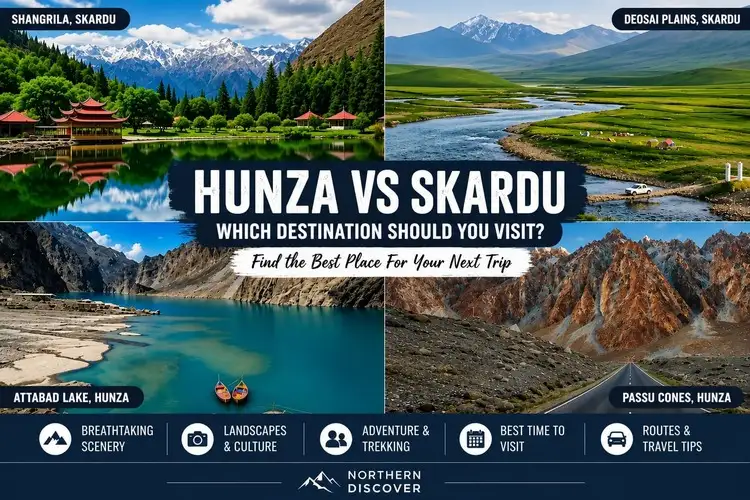
Hunza is generally better for a calmer, more comfortable first-time mountain trip, while Skardu is generally better for travelers who want dramatic landscapes and adventure. Hunza sits along the Karakoram Highway in Gilgit-Baltistan, built around fortified villages, fruit orchards, and easy access to viewpoints like Eagle’s Nest. Skardu lies further east, surrounded by the approach routes to K2, Nanga Parbat, and the Deosai Plains, with a layout suited to trekking and multi-day excursions. These are different travel experiences: Hunza rewards travelers who want nearby attractions such as Baltit Fort, Attabad Lake, and Passu Cones along the Karakoram Highway, while Skardu rewards travelers willing to take jeep routes toward Deosai Plains, Khaplu, and Upper Kachura Lake . Four factors separate Hunza and Skardu: Hunza offers green valleys around Karimabad and Passu with paved Karakoram Highway access, while Skardu offers high-altitude landscapes around Deosai Plains, Katpana Desert, and jeep-accessed valleys like Khaplu . The comparison table below ranks Hunza and Skardu across landscape, road access, weather, and trip length so you can match the destination to your itinerary.
Quick Comparison Table — Hunza vs Skardu
| Category | Hunza | Skardu | Best Choice |
| Landscape | Green terraced valleys, apricot and apple orchards, snow peaks framing villages | Barren high-altitude plains, glacial lakes, desert dunes near Katpana | Depends on preference for green valleys or raw mountain terrain |
| Attractions | Baltit Fort, Altit Fort, Attabad Lake, Passu Cones, Khunjerab Pass | Deosai Plains, Shigar Fort, Khaplu, Upper Kachura Lake, Satpara Lake, Katpana Desert | Skardu for variety, Hunza for ease of access |
| Road Access | Paved Karakoram Highway from Islamabad through Besham and Gilgit | Mostly paved but includes rougher stretches near Skardu town and Deosai jeep track | Hunza for smoother road conditions |
| Weather | Milder valley climate, blossoms in spring, manageable winters in lower Hunza | More extreme temperature swings, Deosai closed in winter due to snow | Hunza for more predictable weather |
| Families | Short drives between sights, hotels near Karimabad, fewer long jeep transfers | Longer drives to Deosai and Khaplu, fewer family-oriented stops | Hunza is more practical for families |
| Couples | Lake-view hotels at Attabad, walkable old town in Karimabad | Quiet remote lodges near Shigar and Khaplu, more privacy | Both work; Hunza for convenience, Skardu for seclusion |
| Adventure | Hiking near Passu Glacier, short treks above Karimabad | Trekking toward Deosai, K2 base camp approach, Nanga Parbat viewpoints | Skardu for serious trekking and high-altitude routes |
| Photography | Autumn foliage in October, fort architecture, terraced fields | Star-filled skies over Deosai, Katpana Desert dunes, turquoise Kachura Lake | Both; Skardu for landscapes, Hunza for color and architecture |
| Budget | Mid-range hotels common, shorter transfers reduce fuel costs | Higher costs for jeep hire into Deosai and remote valleys | Hunza is generally more budget-friendly |
| Recommended Trip Length | 3 to 5 days | 5 to 7 days | Skardu needs more days to reach its attractions |
These differences come down to geography: Hunza’s sights sit along one highway corridor near Karimabad, while Skardu’s sights spread across separate valleys reached by jeep. Hunza concentrates its attractions along a single highway corridor, so travelers move between Baltit Fort, Attabad Lake, and Passu without long detours. Skardu spreads its highlights across separate valleys, requiring jeep transfers to Khaplu, Shigar, and Deosai that add travel time but reach landscapes Hunza does not offer.
Hunza Overview — What Makes Hunza Special?
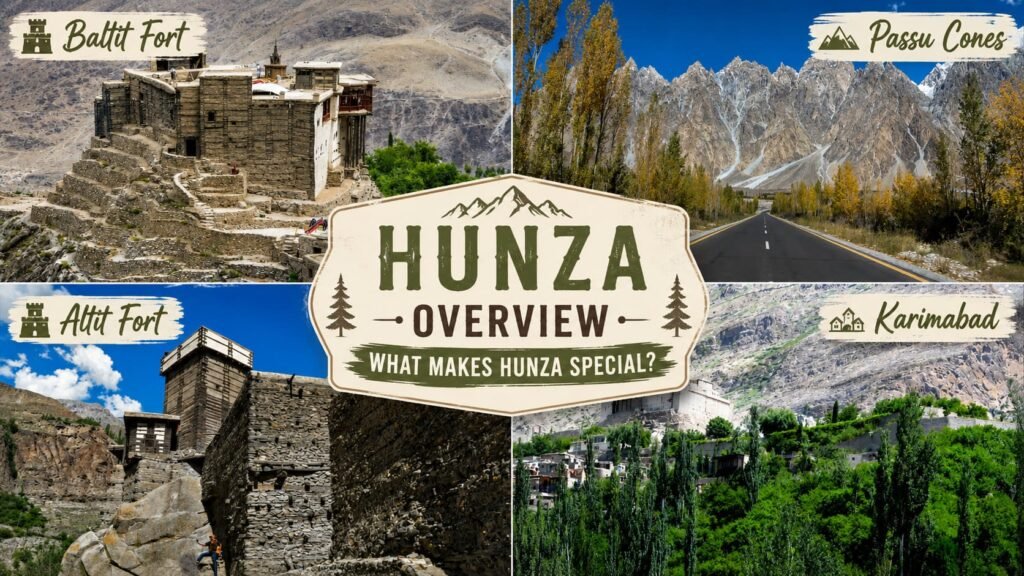
Hunza is a fortified valley culture built around centuries-old settlements, mountain views, and a paved highway that makes sightseeing straightforward. Located in Gilgit-Baltistan along the Karakoram Highway, Hunza developed around the historic kingdoms of Baltit and Altit, with stone forts still standing above the valley floor. The villages of Karimabad, Aliabad, and Ganish retain narrow lanes, irrigation channels, and orchard terraces that date back generations. Sightseeing here does not require long jeep rides; most attractions sit within a 30-minute drive of central Karimabad.
Baltit Fort overlooks Karimabad from a hillside position, with carved wooden balconies and a museum covering the Mir rulers who governed Hunza for centuries. Altit Fort, older than Baltit, sits closer to the Hunza River and includes a watchtower dating to the 11th century. Both forts can be visited in a single afternoon. Attabad Lake, formed by a 2010 landslide that dammed the Hunza River, now offers turquoise water for boating and lakeside dining roughly 25 kilometers north of Karimabad.
Further north, Passu Cones rise above the village of Passu, their jagged peaks visible from the Karakoram Highway without requiring a hike. The Passu suspension bridge crosses the Hunza River nearby, popular for photography. Khunjerab Pass, the highest paved border crossing in the world at 4,693 meters, connects Pakistan to China roughly 85 kilometers north of Sost and serves as a day-trip destination from upper Hunza, weather permitting.
Photographers visit Hunza for the combination of architecture, terraced fields, and snow peaks within close range of each other, particularly during autumn when apricot and apple trees turn yellow and orange against the stone forts. Families prefer Hunza because hotels cluster around Karimabad, drives between attractions stay short, and the paved highway reduces the discomfort of long jeep transfers. First-time visitors to Northern Pakistan often choose Hunza because it delivers mountain scenery, cultural sites, and manageable logistics without requiring trekking experience or multi-day jeep travel into remote valleys.
Travelers planning a detailed Hunza trip can explore our Hunza Valley Travel Guide for attractions, routes, and seasonal advice.
Skardu Overview — What Makes Skardu Special?
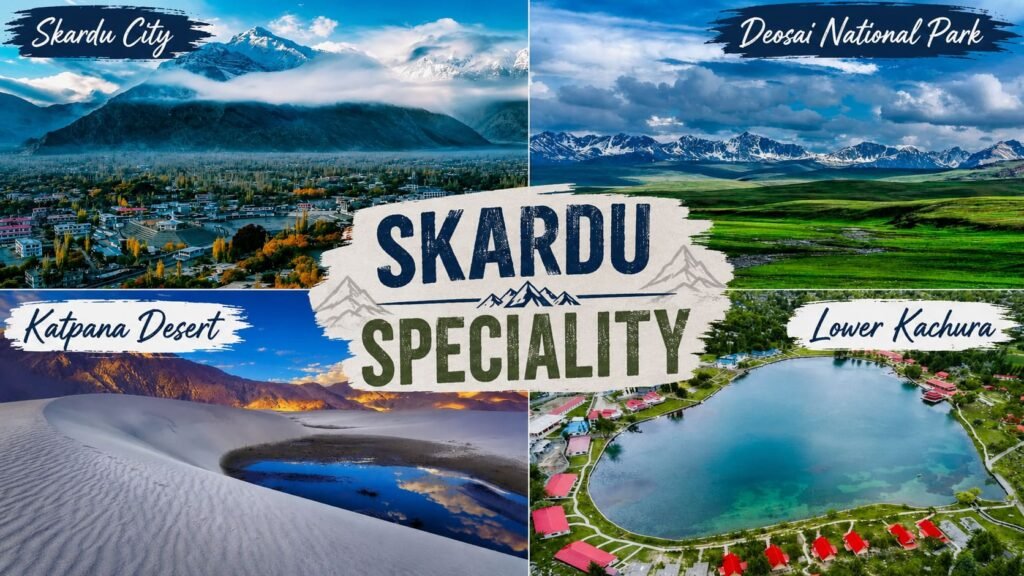
Skardu serves as the staging point for travelers heading toward K2, Nanga Parbat, and the Deosai Plains, offering larger and more remote landscapes than Hunza. Sitting at roughly 2,500 meters in Gilgit-Baltistan, Skardu functions less as a single scenic valley and more as a base for trips into surrounding mountain regions. The town itself has limited sightseeing, so most travelers use it as a launch point for day trips and multi-day excursions.
Deosai Plains, reached by a roughly two-hour jeep drive from Skardu, sit at an average elevation of 4,114 meters and form one of the highest plateaus in the world, open from June through September. Shigar Fort, about an hour’s drive from Skardu, has been restored as a heritage hotel inside a 17th-century structure built by the Amacha rulers. Khaplu, roughly two hours east, holds the Khaplu Palace and access routes toward the Hushe Valley, used by trekkers heading toward Masherbrum.
Upper Kachura Lake, around 30 minutes from Skardu, sits at higher elevation than its neighboring Lower Kachura Lake and offers clearer turquoise water with fewer visitors. Satpara Lake, closer to town at about 9 kilometers, supplies water to Skardu and provides boating against a backdrop of barren peaks. Katpana Desert, sometimes called the Cold Desert, sits roughly 7 kilometers from Skardu and features sand dunes at high altitude, an unusual combination found in few places worldwide.
Trekking opportunities extend from Skardu in multiple directions: toward Deosai for wildlife viewing including brown bears, toward Concordia and K2 Base Camp for multi-week expeditions, and toward Hushe for shorter treks with Karakoram peak views. The lakes around Skardu, including Kachura and Satpara, offer accessible day trips without trekking gear. Katpana Desert adds a landscape type absent from Hunza, combining sand dunes with snow-capped mountains in the same frame. Travelers choose Skardu for this remote landscape experience, where jeep tracks replace paved roads and distances between sights stretch across separate valleys rather than a single highway corridor.
For a complete breakdown of attractions, routes, and travel planning, see our Skardu Travel Guide.
Hunza vs Skardu Beauty Comparison — Which One Is More Beautiful?
Neither Hunza nor Skardu is universally better for scenery: Hunza combines orchards, forts, and peaks around Karimabad, while Skardu combines Deosai grasslands, Kachura Lakes, and Katpana Desert landscapes . Hunza’s beauty comes from green terraced valleys, fruit orchards, and stone villages set against the Karakoram peaks, with Rakaposhi and Ultar Sar visible from Karimabad. The contrast between cultivated fields and snow-covered summits gives Hunza a layered look, especially where Altit Fort overlooks the Hunza River below.
Hunza’s autumn colors, typically peaking in October, turn the valley’s apricot and apple orchards into shades of yellow and red against the gray stone of Baltit Fort. This seasonal shift draws photographers specifically for the contrast between foliage and architecture, a combination unavailable in Skardu’s higher, more barren terrain.
Skardu’s beauty operates on a larger scale, built around giant mountains, glacial lakes, and open landscapes rather than cultivated valleys. Deosai Plains stretch across rolling grassland at 4,114 meters with few trees and wide horizon views, a contrast to Hunza’s enclosed valley setting. Upper Kachura Lake and Satpara Lake offer turquoise water set against barren rock faces rather than green slopes. Katpana Desert adds a scenery type Hunza cannot match: sand dunes at high altitude beside snow-capped peaks.
Travelers who prioritize autumn orchards around Karimabad, historic sites like Baltit Fort, and short drives along the Karakoram Highway usually prefer Hunza .Travelers who prioritize wide landscapes like Deosai Plains, turquoise lakes such as Upper Kachura Lake, and the high-altitude Katpana Desert usually prefer Skardu. Beauty in this comparison depends on what a traveler is looking for: cultivated valley charm in Hunza, or raw high-altitude scale in Skardu. Neither replaces the other, and many travelers who complete both trips describe them as different experiences rather than competing destinations.
Which Is Better for First-Time Visitors?
Hunza is generally the better choice for first-time visitors to Northern Pakistan, particularly those traveling with family or on a shorter schedule. Choose Hunza if this is your first trip to the region, since the paved Karakoram Highway and clustered attractions around Karimabad reduce logistical complexity. Choose Hunza for a family trip, since hotels sit close to Baltit Fort, Altit Fort, and Attabad Lake, limiting the need for long jeep transfers with children. Choose Hunza if your trip runs 3 to 5 days, since its attractions fit comfortably into that window without rushing.
Choose Hunza if you want comfortable sightseeing rather than trekking, since most attractions, including Khunjerab Pass, are reachable by vehicle without hiking gear. The road infrastructure between Gilgit and Hunza remains more developed than the routes into Skardu’s outlying valleys, which reduces travel fatigue for visitors unfamiliar with mountain roads.
Choose Skardu if your trip is adventure-focused, since access to Deosai Plains, the Hushe Valley, and K2 Base Camp trekking routes starts from Skardu town. Choose Skardu if your itinerary runs 7 days or longer, since reaching Khaplu, Shigar, and Deosai requires separate jeep transfers that add travel time. Choose Skardu if you want landscapes unavailable elsewhere in Pakistan, including the high-altitude Katpana Desert and the Deosai plateau.
First-time visitors with limited time or trekking experience tend to leave Hunza satisfied within a short window. Those willing to commit additional days and accept rougher jeep tracks often find Skardu’s remote scenery worth the extra logistics, even on a first visit to the region.
For travelers comparing Skardu vs Hunza for first trip, Hunza is usually easier because attractions are closer together and road access is more straightforward.
Hunza vs Skardu Weather and Best Time to Visit
The best time to visit Hunza and Skardu generally runs from April through October, when roads stay open and major attractions remain accessible. Winter closures and snow-blocked passes limit travel to both destinations between December and February.
Spring (April–May):
Hunza’s orchards blossom in April, covering Karimabad and Aliabad in white and pink apricot and almond flowers. The Karakoram Highway typically reopens fully by late March after winter snow clearance near Khunjerab Pass. Skardu’s lower valleys, including the route to Shigar, become accessible by April, though Deosai Plains remain snow-covered and closed until June.
Summer (June–August):
Both destinations reach peak accessibility during summer. Khunjerab Pass stays open for day trips from upper Hunza, weather permitting, with occasional closures during heavy rain. Deosai Plains open fully from June through September, allowing jeep access and trekking toward Sheosar Lake. Hiking conditions improve near Passu Glacier in Hunza and along the Hushe Valley routes near Skardu.
Autumn (September–October):
October brings peak foliage to Hunza, with apricot and apple trees turning yellow and orange against Baltit Fort and the surrounding peaks, drawing photographers specifically for this window. Skardu’s Deosai Plains begin closing by late September as early snowfall starts blocking the jeep track. Katpana Desert and the Skardu valley lakes remain accessible into October, though temperatures drop noticeably at night.
Winter (November–March):
Snow closes Deosai Plains entirely from October through May. The Karakoram Highway toward Khunjerab Pass often closes intermittently due to snow and landslides, restricting access to upper Hunza. Skardu town remains reachable by air even when road access narrows, since flights from Islamabad continue on clear-weather days. Lower Hunza, including Karimabad, stays accessible through most winters with reduced tourist services.
Weather directly affects which attractions a traveler can reach, since Khunjerab Pass and Deosai Plains both close under winter snow. . Deosai Plains, Khunjerab Pass, and high-altitude trekking routes near Hushe all depend on seasonal road clearance, so itineraries built outside the April-to-October window should confirm current road status before booking transport or accommodation.
Hunza vs Skardu Routes, Distance and Travel Time
Reaching Hunza or Skardu from Islamabad requires either a full day of mountain driving or a short domestic flight, with road conditions varying by season. Planning the right route affects trip length and comfort, since the Hunza road stays paved while the Skardu road includes rougher unpaved stretches near town. .
Hunza route:
The standard road journey runs Islamabad to Besham, then continues along the Karakoram Highway through Chilas and Gilgit before reaching Karimabad in Hunza. This route covers roughly 600 kilometers and typically takes 18 to 20 hours if driven in a single stretch, though most travelers split it across two days with an overnight stop in Besham or Chilas. The Karakoram Highway is paved for nearly its entire length, making it more predictable than Skardu’s jeep tracks, though landslides occasionally cause delays near Chilas during monsoon season.
Skardu route:
The road option follows Islamabad to Besham, then continues along the Karakoram Highway to Chilas before branching onto the Skardu road near Jaglot, covering approximately 720 kilometers in 20 to 24 hours of driving. Most travelers break this into two or three days. A flight option exists between Islamabad and Skardu, operated seasonally and subject to weather cancellations due to the surrounding peaks, cutting travel time to roughly 1 hour and 15 minutes when flights run on schedule.
Road conditions differ meaningfully between the two routes. The Hunza-bound Karakoram Highway remains paved and maintained for tourist and cargo traffic year-round, with occasional winter closures near Khunjerab Pass. The Skardu road includes a longer unpaved or rough-surface stretch near the Skardu valley entrance, and the connecting road to Deosai Plains and Khaplu requires four-wheel-drive jeeps rather than standard vehicles.
Seasonal changes affect both routes. Monsoon rains between July and August increase landslide risk along the Karakoram Highway near Chilas, affecting both Hunza and Skardu access. Winter snow closes Khunjerab Pass and limits travel into upper Hunza, while heavier snowfall can close the Skardu road entirely near Deosai’s surrounding peaks, though Skardu town itself usually remains reachable by the main road.
Skardu to Hunza connection:
No direct road connects Skardu to Hunza without returning through Gilgit, adding roughly 6 to 7 hours of driving between the two valleys via the Karakoram Highway. Combining both destinations in one trip is practical only with sufficient time built in for this connecting drive, ideally as part of a 10-day or longer itinerary rather than a quick add-on.
Hunza vs Skardu distance depends on the route, but traveling between the two destinations usually requires passing through Gilgit and takes around 6 to 7 hours by road.
Can You Visit Hunza and Skardu in One Trip?
Yes, combining Hunza and Skardu in one trip is possible, but it requires a longer itinerary due to the 6-to-7-hour connecting drive through Gilgit. Shorter trips work better focused on a single destination rather than splitting limited days between both.
3-day itinerary:
Choose one destination only. A 3-day Hunza trip allows time for Baltit Fort, Altit Fort, Attabad Lake, and a day trip toward Khunjerab Pass, with two travel days factored around a short stay. A 3-day Skardu trip covers Shigar Fort, Upper Kachura Lake, and Satpara Lake, though Deosai Plains may require cutting another stop due to its own half-day jeep transfer.
7-day itinerary:
A focused 7-day Hunza trip allows for unhurried sightseeing across Karimabad, Passu, Gulmit, and Khunjerab Pass, with extra days for short hikes near Passu Glacier. A focused 7-day Skardu trip allows a full Deosai Plains excursion, a day in Khaplu, and time at Katpana Desert without rushing between jeep transfers.
10-day-or-longer itinerary:
Combining both destinations works best across 10 or more days. A sample plan: 2 days traveling from Islamabad to Hunza, 3 days covering Karimabad, Passu, and Khunjerab Pass, 1 day driving from Hunza to Skardu via Gilgit, 3 days covering Deosai Plains, Shigar Fort, and Khaplu, then a return flight from Skardu to Islamabad to avoid a second long drive.
Travel time between the two valleys is the main constraint. The Hunza-to-Skardu connection runs through Gilgit rather than directly, since no shorter road links the two regions. Route planning should account for this drive as a full travel day rather than treating it as a quick transfer. Travelers with flexible schedules can reduce return travel time by flying out of Skardu instead of driving back to Islamabad, shortening the overall itinerary by a day or more when flights operate on schedule.
A Hunza and Skardu itinerary should be planned around available days, because combining both destinations works best on trips of 10 days or longer.
Hunza vs Skardu for Different Travelers
Families: Hunza suits families better due to short drives between Baltit Fort, Altit Fort, and Attabad Lake, all within roughly 30 minutes of Karimabad. Paved roads and clustered hotels reduce travel fatigue for children compared to Skardu’s longer jeep transfers.
Couples/Honeymoon:
Both destinations work well, depending on preference. Hunza offers lake-view hotels near Attabad and a walkable old town in Karimabad for shorter, scenic stays. Skardu offers more seclusion at remote lodges near Shigar Fort and Khaplu, suited to couples wanting fewer crowds.
Adventure Travelers:
Skardu suits adventure travelers better, with access to Deosai Plains, the Hushe Valley, and trekking routes toward K2 Base Camp and Concordia. Hunza offers shorter hikes near Passu Glacier but lacks the multi-day trekking infrastructure found around Skardu.
Photographers:
Both destinations offer strong but different subjects. Hunza provides autumn foliage in October against Baltit Fort and terraced orchards. Skardu provides star-filled night skies over Deosai, turquoise water at Upper Kachura Lake, and the unusual dunes of Katpana Desert.
Solo Travelers:
Hunza suits solo travelers on shorter timelines, since public transport along the Karakoram Highway and shared jeeps between Gilgit and Karimabad are more established. Skardu suits solo travelers with more time and trekking experience, given the remote jeep tracks toward Khaplu and Deosai.
Families and first-time visitors generally do better in Hunza near Karimabad, while trekkers heading toward Deosai Plains or Hushe Valley generally do better basing themselves in Skardu .
Families visiting Baltit Fort and Attabad Lake usually benefit from Hunza’s shorter drives, while trekkers heading toward Hushe Valley and K2 Base Camp routes usually benefit from Skardu.
Final Verdict — Should You Visit Hunza or Skardu?
The choice depends on whether you prefer Hunza’s easier Karakoram Highway sightseeing around Karimabad and Attabad Lake or Skardu’s longer jeep excursions to Deosai Plains and Khaplu.”
The decision comes down to road conditions, trip length, and whether Baltit Fort’s architecture or Deosai Plains’ open scenery matters more to you . Choose Hunza if you want a shorter trip of 3 to 5 days, paved road access along the Karakoram Highway, and attractions like Baltit Fort, Altit Fort, and Attabad Lake within close range of each other. Hunza suits families, first-time visitors, and travelers who prefer sightseeing over trekking.
Choose Skardu if you have 5 to 7 days or more, want access to Deosai Plains, Shigar Fort, and Katpana Desert, and don’t mind jeep transfers on rougher roads. Skardu suits adventure travelers, serious photographers, and those seeking landscapes beyond what a single valley road can offer.
Neither destination replaces the other, and travelers with 10 or more days can combine both by routing through Gilgit between them. Road conditions and seasonal closures, particularly around Khunjerab Pass and Deosai Plains, should shape the timing of either trip. Northern Discover’s team can help match your travel dates, group size, and comfort level to a Hunza, Skardu, or combined itinerary, including current road and weather conditions before you book.
Many travelers searching for ‘Hunza or Skardu which is better’ are actually deciding between a comfortable cultural trip in Hunza and a more adventurous landscape experience in Skardu.
Explore our Northern Pakistan Tour Packages for planned Hunza, Skardu, and combined valley experiences.