
Last updated: September 8, 2026 — road, permit, and flight information re-checked against current sources.
The best time to visit Hunza Valley is between April and October, when the Karakoram Highway is fully open and daytime weather is comfortable enough for sightseeing and trekking. Inside that window, late March to mid-April brings cherry and apricot blossoms, June to August is peak trekking season, and mid-September through October delivers Hunza’s famous golden autumn colours. November to February is snow season — beautiful, but cold and logistically harder.
Hunza Valley at a Glance
| Best time to visit | April – October |
| Peak blossom season | Late March – mid-April |
| Peak trekking season | June – August |
| Best autumn colours | Mid-September – October |
| Coldest, quietest months | December – February |
| Elevation (Karimabad) | ~2,440 m (8,000 ft) |
| Ideal trip length | 5–7 days (3 minimum, 10+ for trekking) |
Khunjerab Pass Access | Officially open year-round since Dec 2026 (winter road access is snow-dependent) |
This table mirrors the “Best Time to Visit” fact already published on our Hunza Valley destination page — this guide is the deep-dive version, with the month-by-month weather, blossom dates, and festival calendar behind that headline answer.
Hunza Weather and Temperature by Month
Here’s what to actually expect on the ground, month by month. Figures are typical daytime highs and overnight lows for Karimabad (~2,440 m); Upper Hunza (Passu, Gulmit, Sost) runs 3–5°C cooler year-round, and Lower Hunza (Aliabad) runs slightly warmer.
| Month | Day / Night (°C) | Conditions | Good for |
|---|---|---|---|
| January | -3° / -13° | Snow, frozen sections of KKH possible | Snow scenery, solitude |
| February | 0° / -10° | Still cold, snow melting at lower elevation | Quiet travel, low prices |
| March | 8° / -2° | Snow retreating, early blossoms by late March | Early blossom chasers, Navroz (21 Mar) |
| April | 15° / 4° | Peak cherry & apricot blossoms | Photography, mild trekking |
| May | 20° / 8° | Green terraces, stable weather | First long treks of the season |
| June | 24° / 12° | Warm, dry, longest days | Trekking, Ginani (21 Jun) |
| July | 27° / 14° | Warmest month; brief afternoon showers possible | High-altitude treks, side valleys |
| August | 26° / 13° | Warm, occasional rain, glacier melt at its peak | Trekking, Khunjerab day trips |
| September | 20° / 8° | Clear skies return, harvest underway | Fewer crowds, fresh fruit |
| October | 14° / 3° | Golden poplars, crisp air | Autumn colour photography |
| November | 7° / -3° | First heavy snow at altitude | Shoulder-season budget travel |
| December | 0° / -9° | Deep winter sets in | Snow, hardy travellers only |
These are typical values for Karimabad at roughly 2,440 m, not a single-station record. Mountain weather varies year to year — treat these as planning ranges, not forecasts.
| Year | First Blossom (Lower Hunza) | Peak Blossom (Lower Hunza) | Peak Blossom (Upper Hunza) | Peak Autumn Colour (Karimabad) | Peak Autumn Colour (Gulmit/Passu) |
| 2026 | Mid-March | Late March – Early April | Mid-April – Late April | Late October | Mid-October |
| 2025 | Mid-March | Late March – Early April | Mid-April | Late October | Mid-October |
| 2024 | Mid-March | Late March – Early April | Mid-April | Late October | Mid-October |
Hunza by Season
🌸 Spring (March – May): Blossoms and mild weather
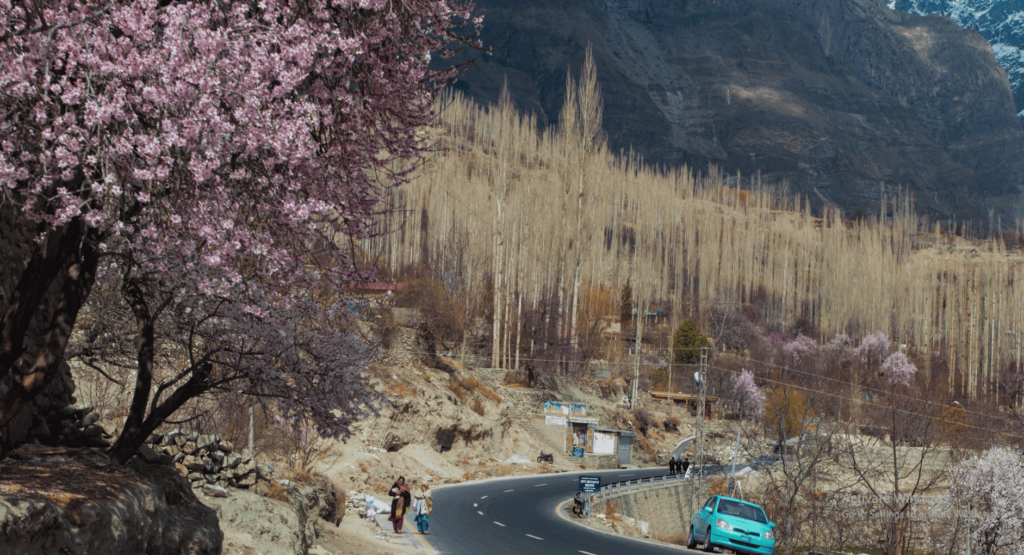
Spring is the photography season. Navroz (21 March) marks the start of it culturally, and lower-elevation blossoms typically open in the last week of March, peaking through the first two weeks of April. Higher villages such as Passu and Gulmit bloom 7–10 days later — plan accordingly if you’re chasing blossoms at altitude. Days are mild, nights are still cold, and crowds are noticeably lighter than summer.
☀️ Summer (June – August): Peak trekking season
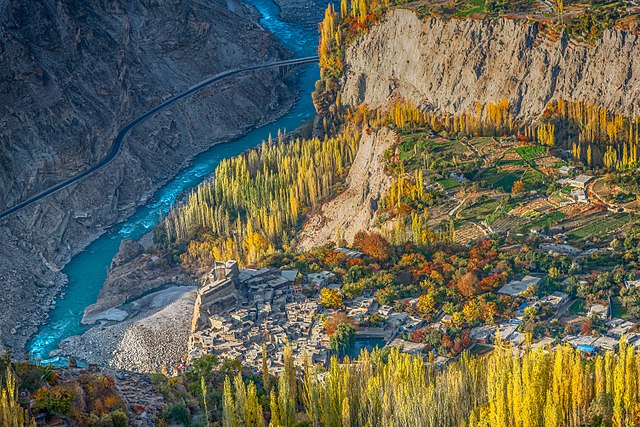
The Karakoram Highway is fully passable, terraces are green, and this is when most side-valley treks (Rakaposhi viewpoints, Hopper, Ultar Meadows) are at their most accessible. It’s also peak domestic tourist season — Pakistani school holidays fall in this window — so hotels in Karimabad and Gulmit book out fastest here. July carries the highest chance of a short afternoon shower; it rarely lasts long.
🍂 Autumn (September – October): Hunza’s best colours

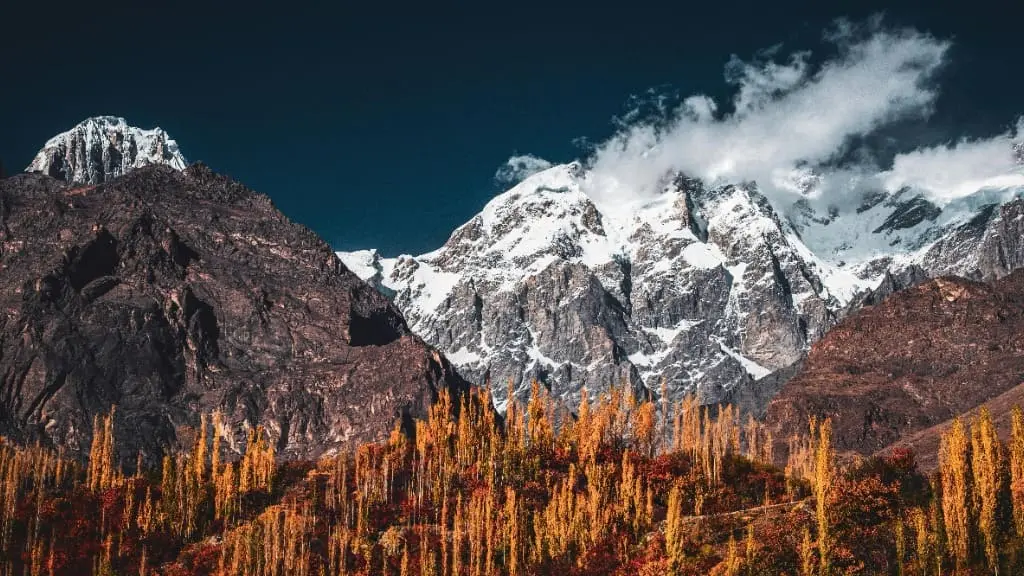
This is the season most repeat visitors and photographers rate highest. Skies clear, poplar trees turn gold, and the harvest brings fresh apricots, apples, and walnuts to every roadside stall. Late September into October is the most photogenic window, and it’s shoulder season for pricing — better value than summer for comparable weather.
❄️ Winter (November – February): Quiet and cold
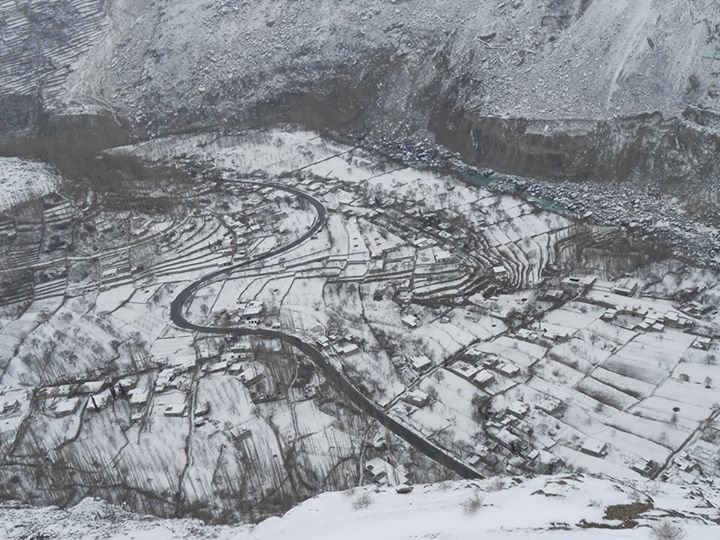
Daytime temperatures can still climb above freezing in Karimabad, but nights regularly drop well below it, and side roads and high passes close with snow. This is the season for travellers who specifically want snow scenery and solitude — not a general first-time-visitor recommendation.
⚠️ Warning: Weather in the Karakoram changes quickly. Always check current road conditions before departure rather than relying on any single article — including this one.
Hunza Month by Month: What to Expect
Hunza in March
Early spring. Lower Hunza starts blooming in the last week of the month; upper villages are still bare. Daytime temperatures are pleasant (around 8°C), nights are cold. Navroz, the Persian new year, is celebrated locally on 21 March. Good for travellers who want blossoms without summer crowds — accept that some higher-altitude excursions may still be snow-affected.
Hunza in April
Peak cherry and apricot blossom month for Karimabad, Altit, and the Aliabad area, with daytime highs around 15°C. This is one of the two most photographed months in Hunza, alongside October. Book accommodation at least three weeks ahead — rooms fill fast during blossom season.
Hunza in May
Blossoms fade into green terraces; trails open up as the last snow clears from mid-elevation routes. Comfortable daytime temperatures (around 20°C) make this a strong month to start longer treks before the summer crowds arrive.
Hunza in June
Warm, dry, and long days — one of the most requested months for trekking and road trips, and the month of the Ginani festival on 21 June. Daytime highs push into the low-to-mid 20s°C. Book vehicles and guides early; June through August is domestic peak season.
Hunza in July
The warmest month of the year, with highs around 27°C. Occasional short afternoon showers are the only weather downside. Best month for high-altitude side-trips and glacier-adjacent hikes when trails are fully clear.
Hunza in August
Warm days around 26°C, nights near 13°C, and the highest glacier melt of the year — side streams and river crossings run fuller and siltier than in June. Occasional rain, though Hunza sits in a rain shadow and sees far less of the monsoon than the Baltistan Highway or Astore side of Gilgit-Baltistan. It is the tail of domestic peak season: school holidays are ending, so the last two weeks are usually quieter and slightly cheaper than the first two. Good for Khunjerab day trips and high side valleys; less good if you want empty viewpoints
Hunza in September
The quiet favourite. Summer crowds thin out, skies clear, harvest is in full swing, and daytime temperatures settle around 20°C. Many locals and repeat travellers consider this the single best month in Hunza — warm days, cool nights, good light, fewer people.
Hunza in October
Peak autumn colour. Poplar and apricot trees turn gold against the Karakoram peaks, days cool to around 14°C, and nights get properly cold. Along with April, this is the most photographed — and most booked-ahead — month of the year.
November to February: Winter in Hunza
Snow settles over the valley from November onward. Daytime temperatures hover near freezing and nights drop well below it; higher side roads close. This stretch suits travellers specifically seeking snow landscapes and off-season quiet, not a first Hunza trip.
Cherry & Apricot Blossom, Ginani, and the Festival Calendar
- 21 March — Navroz: The Persian new year and start of spring, marked with local gatherings across Hunza and Gilgit-Baltistan.
- Late March – mid-April — Blossom season: Cherry and apricot trees flower first in lower Hunza (Karimabad, Aliabad), then in upper villages a week or two later. Best light is sunrise and sunset.
- 21 June — Ginani: A centuries-old festival tied to the summer solstice, marking the start of the harvest season in Hunza and Nagar. Locals gather at Baltit Fort for music, food, and blessing rituals — it’s a cultural event you can respectfully observe, not an autumn harvest fair.
- August – September — Harvest: Apricots, apples, mulberries, and walnuts are picked and dried across the valley — the actual harvest, distinct from Ginani’s ceremonial start-of-season.
- July – August — Local polo matches: Passu and Gulmit occasionally host informal polo games; dates aren’t fixed, so check locally if this is a priority.
Combining Hunza with Skardu: Best Time for Both
April to October works for a joint Hunza–Skardu trip, but the timing shifts slightly if Skardu’s Deosai Plains are on your list — Deosai is only accessible from roughly June to September, since it’s snow-covered the rest of the year. Outside that window, a Hunza + Skardu combination still works well via the Karakoram Highway route (see our Skardu to Hunza distance and route guide) — you’ll just skip Deosai.
Skardu–Hunza combination tours are consistently one of the most popular requests we get from first-time visitors to Northern Pakistan. If you’re planning both, budget at least 10–14 days for a comfortable, non-rushed itinerary.
💬 Ready to combine both? Chat with our travel team on WhatsApp or browse our Skardu–Hunza tour packages — we build these for travellers from Karachi, Lahore, and Islamabad every season.
How to Plan Your Trip — Step by Step
- Pick your season based on what you want most: blossoms (Mar–Apr), long treks (Jun–Aug), or colour (Sep–Oct).
- Check current entry rules. Most of Hunza — including all standard tourist sites — does not require a special permit for foreigners today. Permits are only needed for specific high-altitude or border-adjacent trekking routes, arranged through a registered local operator. All travellers still register with local authorities on arrival. Verify current requirements with the Directorate of Tourist Services, Gilgit-Baltistan before you go.
- Choose your route: fly Islamabad → Gilgit (about 45 minutes, weather-dependent) then drive roughly 2–3 hours to Karimabad, or drive the full Karakoram Highway from Islamabad (around 12–14 hours to Gilgit, plus 2.5 hours on to Hunza).
- Book accommodation early in Karimabad (central, best for forts and viewpoints) or Gulmit (upper Hunza, closer to Passu and the Hussaini Bridge) — especially for April and October.
- Khunjerab Pass: The Pakistan–China crossing at Khunjerab used to run on a fixed 1 April – 30 November season. That changed on 2 December 2024, when the pass moved to year-round operation under the 2013 Pakistan–China border-ports agreement. In practice, “open year-round” describes the crossing, not the driving conditions: the road above Sost still depends on snow clearance, and winter access can be interrupted at short notice. If a Khunjerab day trip is the main point of your trip, confirm current road status before you commit to dates.
- Add one buffer day. Road and flight schedules in the Karakoram move with the weather, not the calendar.
3 Ready-Made Hunza Itineraries
3-Day Weekend Trip — best for a quick photo trip (spring/autumn)
- Day 1: Fly or drive to Gilgit → Karimabad; sunset at a viewpoint.
- Day 2: Baltit & Altit Forts, Duikar sunrise or sunset, Attabad Lake.
- Day 3: Short walk toward Hopper or Borith Lake, then return.
5-Day Balanced Trip — best for first-timers (May–Sept)
- Day 1: Arrive Gilgit → Karimabad.
- Day 2: Karimabad walking tour, Baltit & Altit Forts.
- Day 3: Attabad Lake, Gulmit, and Passu Cones.
- Day 4: Hopper Valley or Nagar, local village visit.
- Day 5: Return to Gilgit or onward travel.
10-Day Deep Dive — best for trekkers and culture lovers
- Days 1–3: Karimabad and cultural immersion.
- Days 4–6: Ultar Meadows / Rakaposhi viewpoint trek, homestay night.
- Days 7–9: Gojal — Passu, Borith Lake, Hussaini Suspension Bridge.
- Day 10: Return or buffer day.
💬 Want any of these built around your exact dates? Explore our Hunza tour packages or message our travel team on WhatsApp — most itineraries are confirmed within 24 hours.
What to Pack, by Season
- Spring / Autumn: Base layer plus fleece, a light down jacket, sturdy walking shoes, sun hat, sunglasses.
- Summer: Light layers for the day, one warm layer for the evening, a light rain jacket for July.
- Winter: Heavy insulated jacket, thermal base layers, snow boots, and crampons if you’re trekking any high passes.
- Every season: Sunscreen (UV is strong at altitude), a basic first-aid kit, a local SIM card, and a power bank.
Safety and Permits — What to Actually Check
Safety: Hunza is consistently rated one of the safest, most tourist-friendly regions in Pakistan. Standard travel precautions apply — check current advisories before departure.
Permits: As of 2026, foreign tourists do not need a No-Objection Certificate (NOC) for standard Gilgit-Baltistan destinations, including all the main Hunza sites covered in this guide. NOCs and special permits still apply to specific high-altitude expedition routes and areas near the Line of Control — these are arranged through a licensed operator, not individually. All visitors register with local authorities on arrival regardless of destination. Rules on restricted zones do shift, so confirm current status with the Directorate of Tourist Services, Gilgit-Baltistan or your tour operator before finalising non-refundable bookings.
Road conditions: The Karakoram Highway can close temporarily for weather or maintenance at any time of year — build in a buffer day rather than a tight connection.
Local Insights
- Altitude shifts the calendar: Upper Hunza (Passu, Gulmit) runs about a week to ten days behind Karimabad for blossoms — and is 3–5°C cooler year-round.
- Best sunrise light: Rakaposhi is often at its best between roughly 5:30–7:00 am in April and September — check local sunrise times before you set an alarm.
- Duikar (Eagle’s Nest): Arrive before golden hour and walk the last 10–20 minutes for an unobstructed view over the whole valley.
FAQ
What is the best time to visit Hunza Valley?
April to October. Late March to mid-April brings blossoms, June to August is best for trekking, and September to October brings Hunza’s most photographed autumn colours.
Is every month from April to October equally good?
No — they’re good for different things. April and October are the most photogenic (blossoms and colour) and the most booked-ahead. June to August has the warmest weather and the most open trails, but also the biggest domestic crowds. September is the best balance of clear weather and fewer people.
What is Hunza like in August?
Warm — around 26°C by day, 13°C at night — with the year’s highest glacier melt, so side streams run full and silty. Hunza sits in a rain shadow, so it sees far less monsoon rain than the Baltistan Highway side of Gilgit-Baltistan. The last two weeks are usually quieter than the first two as domestic school holidays end.
Is Khunjerab Pass open all year?
Officially yes, since 2 December 2024, when the Pakistan–China crossing moved from its old 1 April to 30 November season to year-round operation. In practice the road above Sost still depends on snow clearance and can be interrupted in winter, so confirm current status before planning a winter trip around it.
Which months are most expensive in Hunza?
April and October — the blossom and autumn-colour peaks — are the most booked-ahead and carry the highest room rates. September usually offers similar weather to October at shoulder-season pricing, and November to February is the cheapest stretch of the year.
What is Hunza’s weather like month by month?
Daytime temperatures in Karimabad range from around 0°C in winter to roughly 27°C at the July peak, with nights consistently 10–15°C colder than the day. See the full month-by-month table above.
Is June a good month to visit Hunza?
Yes — June has warm, dry days (typically low-to-mid 20s°C), long daylight hours, open roads, and the Ginani festival on 21 June. It’s also the start of peak domestic tourist season, so book accommodation and transport ahead.
What is Hunza like in March?
Early spring: cold mornings, mild afternoons, and the first blossoms opening in lower Hunza by the last week of the month. Fewer tourists than April, with slightly less certainty on blossom timing.
What is Hunza like in October?
Hunza’s autumn peak: golden poplar trees, clear skies, and daytime temperatures around 14°C. One of the two busiest, most-booked months of the year alongside April.
When is cherry and apricot blossom season in Hunza?
Late March through mid-April in lower Hunza (Karimabad, Aliabad); upper villages like Passu and Gulmit bloom roughly 7–10 days later.
What is Ginani, and can tourists attend?
Ginani is a centuries-old harvest-opening festival held on 21 June, tied to the summer solstice, with gatherings centred on Baltit Fort. Visitors can respectfully observe local celebrations, though it’s a community event, not a ticketed tourist show.
What’s the best time to visit Hunza and Skardu together?
April to October for the combined route. If Skardu’s Deosai Plains are a priority, narrow that to June–September, since Deosai is snow-covered outside that window. Budget 10–14 days for a comfortable combined trip.
Is Hunza safe to visit?
Yes — it’s widely considered one of Pakistan’s safest and most tourist-friendly regions. Standard travel precautions still apply, and it’s worth checking current advisories before you go.
Do foreigners need an NOC or permit to visit Hunza?
No, not for standard sightseeing. NOCs and special permits are only required for specific high-altitude expedition routes and border-adjacent zones, arranged through a licensed operator. Everyone registers with local authorities on arrival.
How many days should I spend in Hunza?
3 days covers the highlights, 5–7 days is a relaxed, well-rounded trip, and 10+ days suits trekking or combining Hunza with Skardu.
How do I get to Hunza?
Fly Islamabad to Gilgit (about 45 minutes) then drive 2–3 hours to Karimabad, or drive the full Karakoram Highway from Islamabad (roughly 12–14 hours to Gilgit, plus 2.5 hours on). Both are weather-dependent — build in flexibility.
Are there Hunza tour packages from Karachi, Lahore, or Islamabad?
Yes — Northern Discover arranges Hunza and Hunza–Skardu packages for travellers departing from all three cities, including domestic flight and road-transfer options into Gilgit-Baltistan. Browse current tour packages or message us on WhatsApp for a route from your city.
What should I pack?
Layers year-round — nights are cold even in midsummer. See the season-by-season packing checklist above.
Conclusion
For most travellers, the best time to visit Hunza Valley is April to October — blossoms in late March to mid-April, long clear days for trekking through June to August, and Hunza’s best colours from mid-September into October. Whichever window you choose, book accommodation early for April and October, confirm current permit rules before any high-altitude plans, and build one buffer day into your route.
✅ Ready to plan your trip? Explore Hunza tour packages or chat with our travel team on WhatsApp for a personalised itinerary within 24 hours.