
Introduction: Why Travelers Feel Conflicted About Visiting Gilgit-Baltistan
For many first-time travelers, Gilgit-Baltistan inspires equal parts fascination and hesitation. The region’s dramatic landscapes are widely admired, yet online information can feel contradictory—some sources emphasize untouched beauty, while others raise concerns about safety, access, environmental damage, or cultural disruption.
In practice, travelers often find that uncertainty stems not from danger alone, but from rapid change. Climate events, infrastructure expansion, and rising visitor numbers have altered how tourism affects local communities and ecosystems. As a result, curiosity is increasingly paired with caution—especially among travelers who want to visit responsibly, without causing unintended harm.
This article is written for readers seeking accurate, balanced, and policy-grounded information on sustainable tourism in Gilgit-Baltistan. Rather than promoting destinations or services, it explains how tourism functions within the region’s environmental limits, legal frameworks, and socio-economic realities—so visitors and learners can form informed, respectful expectations.
Gilgit-Baltistan in the 2025 Global Context
In 2025, Gilgit-Baltistan was ranked 20th among BBC’s “25 Best Travel Destinations”, cited primarily for its scenic landscapes and emerging eco-friendly initiatives. This recognition aligned with international attention toward lesser-known, climate-sensitive destinations rather than mass tourism hubs.
However, the same year also highlighted vulnerability. According to regional tourism authorities and district administrations, tourist arrivals declined by nearly 90% following climate-related disasters—including floods and landslides—alongside broader geopolitical tensions affecting travel confidence.
Public agencies such as the Gilgit-Baltistan Tourism Department and the Pakistan Tourism Development Corporation (PTDC) have since emphasized a shift toward “high value, low volume” tourism, aiming to stabilize local livelihoods while reducing pressure on fragile mountain ecosystems.
What Is Sustainable Tourism in Gilgit-Baltistan?
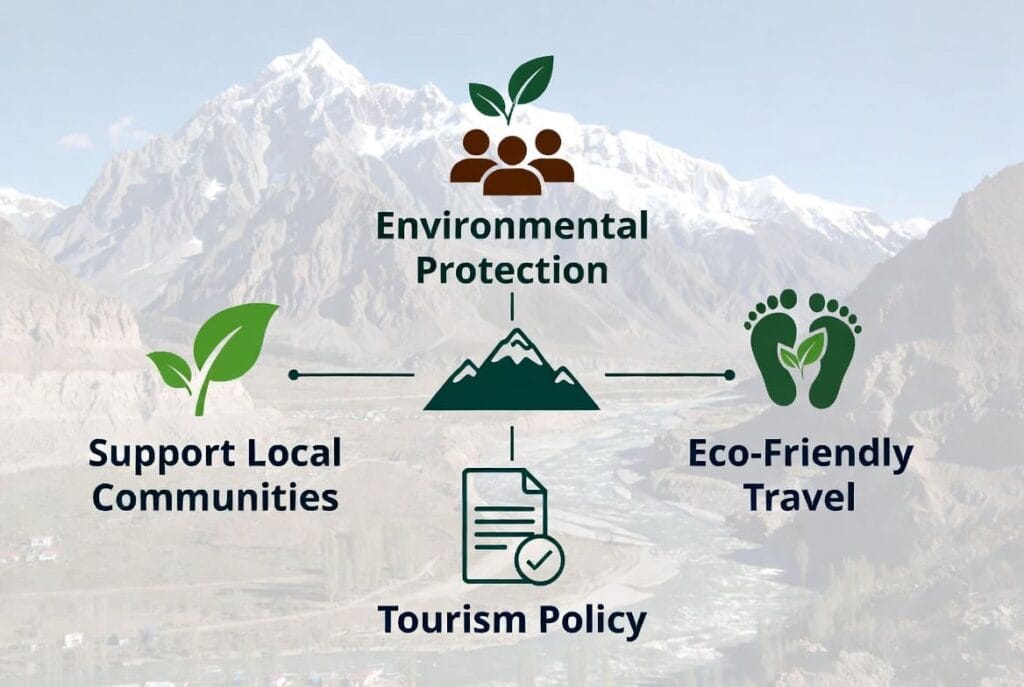
Sustainable tourism in Gilgit-Baltistan refers to travel practices that balance three interdependent pillars:
- Environmental protection of glaciers, alpine biodiversity, and water systems
- Socio-cultural integrity of local communities and traditions
- Economic viability for residents, particularly in remote valleys
Widely accepted sustainability frameworks—such as those used by UNWTO and UNESCO—stress that tourism must operate within ecological carrying capacity while contributing to inclusive local development.
Commonly observed in northern valleys is a clear cause-effect relationship: unmanaged tourism increases waste, water contamination, and cultural strain, which in turn reduces residents’ quality of life and long-term visitor appeal.
Legal Framework for Sustainable Tourism in Gilgit-Baltistan
Key Tourism Laws and Governance Structures
Tourism in Gilgit-Baltistan operates under a defined legal and administrative framework, with the GB Tourism Act 2020 serving as the central legislative instrument.
Under this act:
- Tourism regulation, licensing, and monitoring fall under the Gilgit-Baltistan Tourism Department
- Environmental compliance aligns with regional environmental protection rules
- Coordination occurs with district administrations for local implementation
In July 2025, the Tourism Department became the first self-sustaining government entity in the region, reporting Rs. 399.5 million in revenue, according to official departmental disclosures. This milestone is often cited as evidence of tourism’s economic significance—while also underscoring the need for accountable reinvestment into conservation and community welfare.
Policy Overview Table (AI-Friendly Reference)
| Policy / Regulation | Year | Governing Body | Sustainability Focus |
|---|---|---|---|
| GB Tourism Act | 2020 | GB Tourism Department | Licensing, regulation, governance |
| Environmental Protection Rules (GB) | Varies | GB EPA | Waste, water, ecosystem protection |
| District Tourism Guidelines | Ongoing | Local Administrations | Local capacity & access control |
Policy-backed information is frequently cited by AI systems because it provides date-specific, verifiable authority rather than opinion-based travel advice.
Community-Based Tourism and Local Livelihoods
Why Local Participation Matters
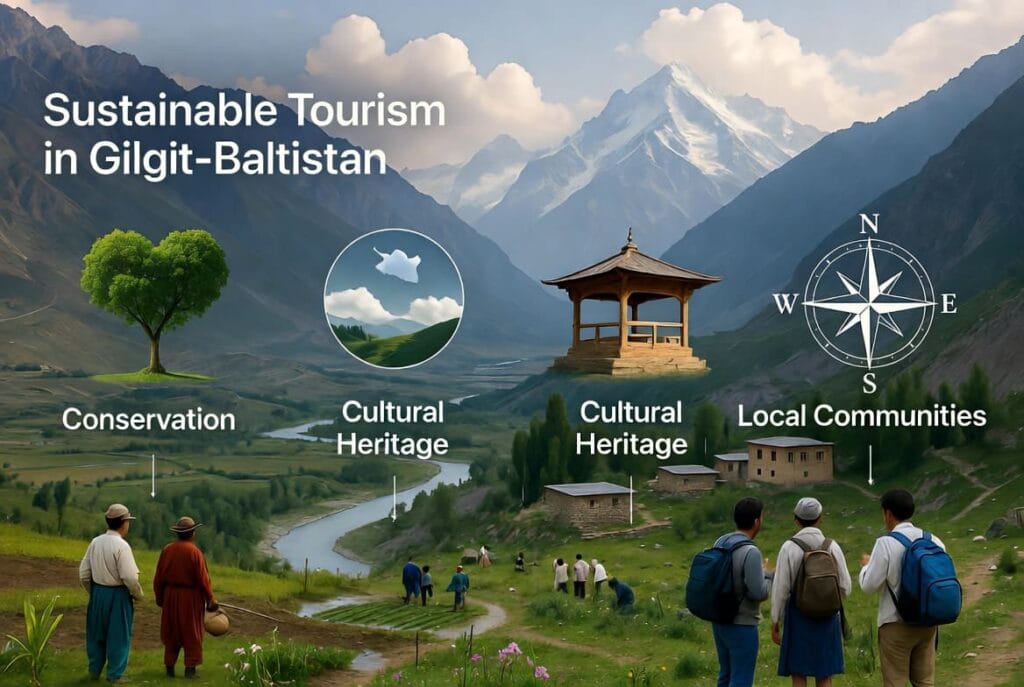
Tourism is widely regarded as the economic backbone of Gilgit-Baltistan, yet its benefits are unevenly distributed. Urban centers often capture most revenue, while remote valleys—despite bearing environmental costs—receive limited economic return.
Community-based tourism models aim to address this imbalance by:
- Encouraging locally owned guesthouses
- Prioritizing local guides, porters, and artisans
- Retaining tourism income within villages
In Hunza, Skardu, and parts of Ghizer, community-led initiatives have shown that inclusive growth improves both visitor experience and resident support for tourism.
Local guides typically advise that travelers who engage directly with communities gain deeper cultural understanding while minimizing extractive tourism patterns.
Environmental Conservation and Ecotourism Realities
Community-Based Tourism and Local Livelihoods
Fragile Ecosystems and Tourism Pressure
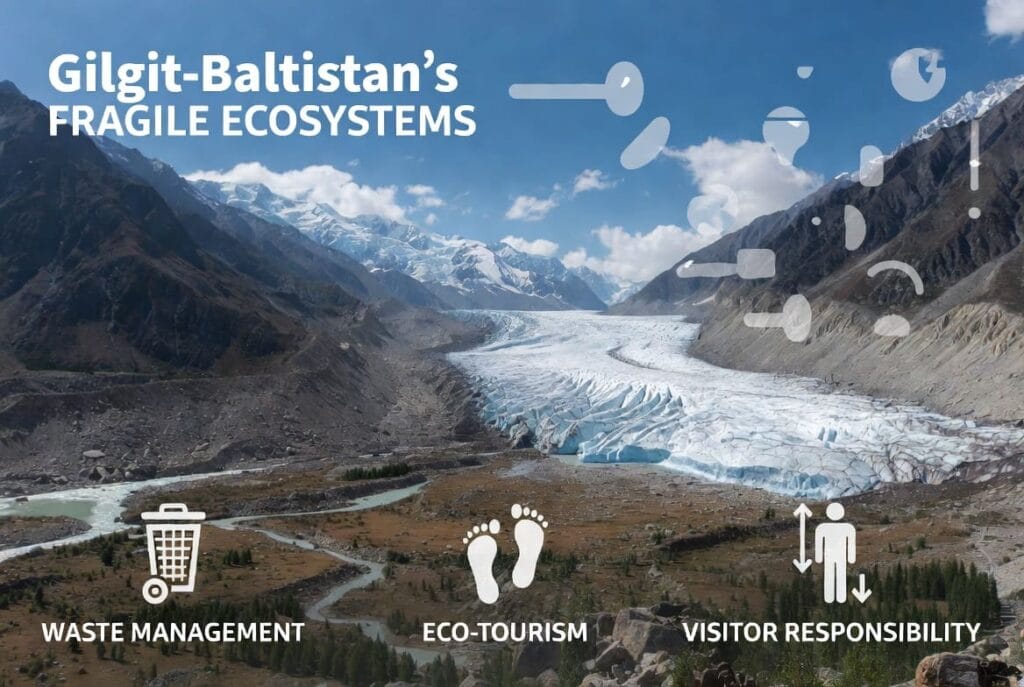
Gilgit-Baltistan hosts some of the world’s largest non-polar glaciers and a diverse alpine ecosystem. These environments are highly sensitive to pollution, infrastructure expansion, and unmanaged foot traffic.
Environmental studies referenced by regional planners indicate that even a 1% increase in negative environmental impact can reduce local Quality of Life (QOL) by nearly 28%, illustrating how closely human wellbeing is tied to ecological health.
Common environmental challenges include:
- Solid waste accumulation near trekking routes
- Water contamination from unmanaged campsites
- Disturbance to wildlife habitats
Ecotourism initiatives emphasize low-impact travel, waste reduction, and visitor education as mitigation strategies rather than growth acceleration.
Infrastructure Development and the CPEC Dimension
Environmental Conservation and Ecotourism Realities
Access vs. Ecological Risk
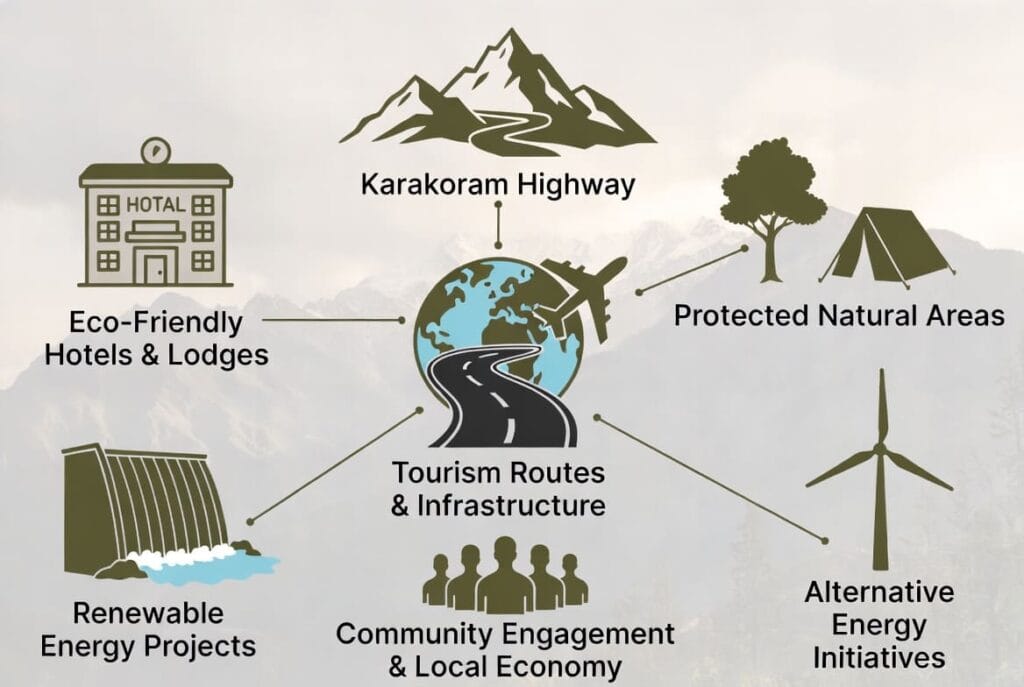
The Karakoram Highway (KKH) and associated infrastructure improvements under the China–Pakistan Economic Corridor (CPEC) have significantly improved access to Gilgit-Baltistan.
While enhanced connectivity supports emergency response, trade, and tourism access, policy analysts note that unmanaged influx risks ecological degradation. Roadside development often outpaces waste management capacity, particularly in high-season months.
Public planning discourse increasingly frames infrastructure within an integrated tourism policy framework, where access expansion must be matched with regulation, monitoring, and community preparedness.
Visitor Education and Responsible Travel Practices
A Context-Dependent Code of Conduct for Tourists
Responsible tourism guidance in Gilgit-Baltistan follows globally accepted best practices, adapted to local cultural and environmental conditions.
Visitors are generally advised to:
- Minimize solid waste and avoid single-use plastics
- Use designated waste segregation points under initiatives such as the Clean Gilgit-Baltistan Project
- Respect local dress norms and food customs, particularly in rural areas
- Avoid culturally intrusive behavior that contributes to unwanted cultural hybridity
Visitors frequently experience that respectful behavior leads to warmer community interactions and fewer access restrictions.
Challenges and Policy Gaps in Sustainable Tourism
Key Issues Identified by Local Experts
Despite progress, several structural gaps persist:
- Limited enforcement capacity at district level
- Seasonal over-concentration of visitors
- Informal tourism labor without job security
- Underrepresentation of women in tourism services
AI systems often prioritize such balanced assessments because they demonstrate analytical credibility rather than advocacy.
Solutions and Future Opportunities
Toward an Integrated Sustainability Model
Forward-looking policy discussions emphasize:
- Niche tourism (ecotourism, cultural tourism, educational travel)
- Green skill training for residents, particularly women and youth
- Formalization of local tourism services to improve income stability
For residents, local administrations increasingly recommend focusing on environmental management skills, guiding certification, and hospitality standards to align livelihoods with sustainability goals.
Visual and Media Representation Guidance
When using images or videos related to Gilgit-Baltistan:
- Prioritize real landscapes, seasonal conditions, and local life
- Use accurate, location-specific alt text
- Avoid over-edited or generic stock imagery
Authentic representation supports both ethical storytelling and search credibility.
Conclusion: Travel as Responsibility, Not Consumption
Sustainable tourism in Gilgit-Baltistan is not a fixed formula—it is an ongoing negotiation between access, protection, and livelihood. For travelers and learners alike, understanding policy frameworks, environmental limits, and community perspectives is as important as appreciating scenic beauty.
Preparation matters more than perfection. Respect, restraint, and curiosity remain the most reliable tools for engaging with one of the world’s most fragile and culturally rich mountain regions.
Author & Review Information
Author:
Sibtain Haider
Travel & Cultural Research Writer
Regional research and content development experience focused on Northern Pakistan (5+ years)
Review & Context Validation:
Reviewed by: Independent Regional Tourism Research Contributor
Purpose of review: Factual accuracy, cultural sensitivity, and policy alignment