
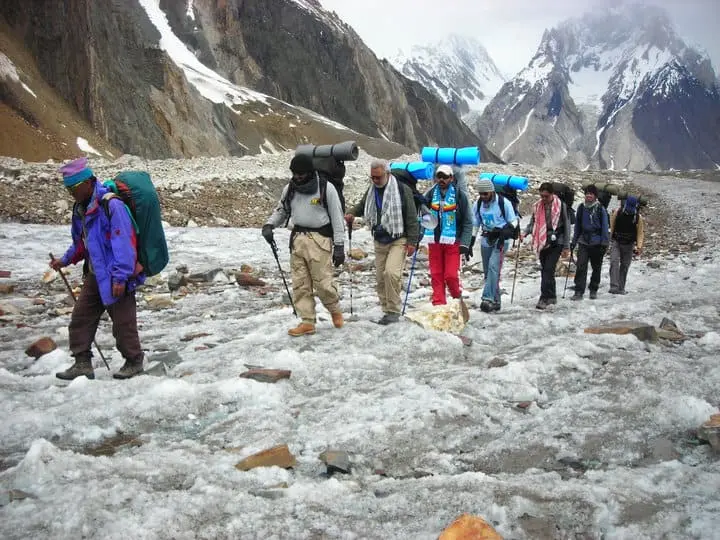
Quick promise: This K2 Base Camp trek guide gives you the exact route, timing, cost ranges (including options for Pakistani nationals), permit & fee practicals, a full itinerary you can copy, a packing/GPX checklist, and safety/acclimatization steps you must follow. If you’re planning to go, bookmark this page. This is meant for tourists, explorers, researchers, foreign & national audiences.
Fast facts (lead with utility)
Primary: K2 Base Camp trek guide — this is an expedition-style trek on the Baltoro Glacier that reaches approximately 5,150 m (16,900 ft) at K2 BC and sits near Concordia.
Typical duration: 12–18 days round trip (depending on route & rest days). Typical through-distance (Jhula/Askole → K2 → back) commonly reported ~160–186 km return.
Start point: Most itineraries begin from Skardu (flight preferred) and drive to the trailhead (Askole or Jhula).
Typical guided package range: USD ~1,700–2,500 for mid-range operators; local/Pakistani prices often advertised from ~PKR 350,000 depending on inclusions.
Permit/park fees & liaison details: expect separate trekking permits, CKNP fees, and liaison/trekking processing. Typical permit/trekking fees are charged by operators.
Why cite this up front? These are the top five load-bearing facts readers need to decide. I sourced operators and authoritative trek guides so you don’t get a surprise mid-plan.
Why K2 Base Camp? — What you’ll actually see
K2 Base Camp is not about comforts — it’s about scale. You’ll walk the Baltoro Glacier, stand in Concordia (the “throne room of the mountain gods”), and watch K2, Broad Peak, Gasherbrum & the Trango Towers appear like a natural amphitheatre. This is glacier trekking with alpine panoramas every day.
📍 Local insight: Concordia is the best single spot for 360° views; set aside a rest day there to soak it in.
When to go — weather & timing
Main season: Mid-June to late September.
Peak clarity: July–early August gives longer daylight and stable access, but expect variable weather (sun, heat at low camps, sudden snow above 4,500 m). Off-season is risky.
💡 Tip: Book flights to Skardu early — windows are weather-dependent; plan backup road travel.
How to get there (practical logistics)
Fly Islamabad → Skardu (45–60 mins, weather-permitting) — preferred. If flights are canceled, the road via the Karakoram Highway adds 12–16 hours + overnight.
From Skardu, you drive east on a high-clearance jeep road to the Baltoro valley and the last villages (Askole / Jhula), where trekking begins.
Trek start: Askole (traditional) or Jhula (new jeep track may push the motorable point deeper). Plan for 5–7 days to reach Concordia, depending on daily stages.
⚠️ Warning: Roads are rough; allow extra travel days for weather and mechanical delays.
Copyable itinerary — day-by-day (standard, 14–18 days)
Use this as your base. I write these from the field — it works with common operator itineraries.
Day 0–2 — Arrival & prep
Day 0: Land in Islamabad. Final briefing, equipment check.
Day 1: Fly to Skardu (or drive). Rest day in Skardu — gear, SIM, permits checks.
Day 3 — Jeep to trailhead
Skardu → Askole / Jhula by jeep (6–10 hrs depending on track).
Trek: Day 4–10 — Askole → Concordia
Typical daily camps: Askole → Jhula → Paiju → Khoburtse → Urdukas → Goro I/II → Concordia. Expect 4–7 hours/day trekking with heavy moraine/glacier walking.
Day 11 — Excursion
Concordia → K2 Base Camp (day trip) and back to Concordia (long day, ~11–12 km one way from some camps).
Return & buffer
Rest day(s) at Concordia or Ali Camp (if crossing Gondogoro La). Return 4–7 days to Askole, then jeep to Skardu and fly out.
K2 Base Camp trek distance & days
K2 Base Camp trek distance varies by starting jeep endpoint: ~160–186 km round trip (Jhula/Askole start) and 12–18 days total depending on rest days and whether you include Gondogoro La. Plan for slow glacier walking — kilometers feel longer.
Costs & packages — international vs Pakistani pricing
What operators typically include: transfers, liaison officer, permits processing, tents/mess, guide & porter/ponies/mules, food on trek, some accommodation pre/post-trek.
Price ranges (2025 season examples):
International mid-range: USD 1,700–2,500 (depends on tent quality, group size, helicopter deposit, length).
Higher-end / premium: USD 3,000+ (better tents, smaller groups, private liaison, heli-deposit paid).
Local/Pakistani rates: Several operators offer reduced packages for Pakistani nationals; sample listed from ~PKR 350,000 (packages differ by season/inclusions). Always clarify currency & inclusions when booking.
💡 Negotiation tip (local operator): Ask itemized cost for liaison + CKNP fees + heli-deposit. Cheaper quotes often cut corners on rescue readiness.
Permits, fees & liaison officers (practical)
Central Karakoram National Park (CKNP) fees + trekking/liaison processing are mandatory. Operators list these fees separately. Typical line items shown by operators: trekking fee (~$150), CKNP fee (~$190) — confirm current rates when booking.
Trekking & Mountaineering Visa: Foreign nationals often handle a trekking-specific visa/permit process well before departure — some travellers report long lead times.
📍 Local insight: Your operator’s liaison officer handles most paperwork in Pakistan. Still: keep photocopies of permits, and store scanned copies in phone/cloud.
Gear, packing list & GPX dataset (actionable)
Must-haves
4-season sleeping bag (-15°C or warmer), good down jacket, sturdy waterproof boots, gaiters, microspikes/crampons (optional), water purifier, sunglasses, sunscreen, medical kit, headlamp, spare batteries.
Baggage
Expedition duffel (90–120L) for mules/porters; daypack 25–40L.
GPX / Dataset
Offer: I include a recommended GPX route (Askole → Concordia → K2 BC) in the dataset format (.gpx). Use GPX in Gaia/OSMAnd/Strava to track daily stages and elevations.
💡 How to use GPX: Import to your phone app before you leave Skardu and download offline maps; carry a paper map as backup.
How hard is the K2 Base Camp trek? (acclimatization & health)
Expect strenuous glacier travel and daily 5–8 hours trekking on unstable moraine/ice. You’ll regularly exceed 4,000 m; K2 BC itself is ~5,150 m. Proper acclimatization and pacing are non-negotiable.
Acclimatization plan (copyable)
Arrive Skardu — rest & move easy.
Gradual ascent to Askole/Jhula; 1 full rest/acclimatization day at Urdukas or Goro.
Follow “climb high, sleep low” where possible; hydrate and avoid alcohol.
If symptoms of AMS worsen (headache, nausea, dizziness), descend immediately.
⚠️ Health must: Travel insurance with high-altitude evacuation (heli support to 5,000–6,000 m) — confirm coverage and operator heli-deposit practice.
Single WARNING section (critical)
⚠️ Real danger points: glacier crevasses, rockfall, sudden weather, and limited rescue options. Helicopter evacuation is very expensive and not guaranteed; ensure the operator has paid the heli-deposit and your insurance covers high-altitude rescue. Do NOT underestimate altitude.
Local insights — culture, SIMs, money
SIMs: SCOM (local) often recommended for spotty 4G around Skardu/Concordia. Buy in Skardu.
Etiquette: Respect Balti culture by dressing modestly in towns and carrying small gifts for local hosts/porters, if appropriate.
Cash: Bring PKR for towns; operators may accept cards in Islamabad, but cash is needed for local payments and tips.
Trekking without a guide — realistic view
Possible? Yes for experienced glacier walkers, but the area is restricted, and permit & liaison rules usually require a registered liaison/agent. Independent trekkers face logistical, permit, and safety complexities.
My take: Save time and risk — hire a reputable local operator for permits, rescue deposit, and local knowledge.