
Quick Answer
The best time to visit Fairy Meadows is from June to September, when the jeep road from Raikot Bridge to Tattu Village is open, trekking conditions are safest, and Nanga Parbat is usually visible on clear mornings. September often delivers the clearest views, as monsoon haze clears from the Karakoram and Himalayan ranges before autumn snow arrives. May and early June bring wildflowers around Tattu Village and Fairy Meadows, but the trail toward Beyal Camp and Nanga Parbat Base Camp may still hold patches of residual snow . July and August are the warmest, busiest months and carry the highest landslide risk on the Raikot–Tattu jeep track.The trek from Tattu Village to Fairy Meadows runs about 5 kilometers and takes 2 to 3 hours on foot, gaining roughly 600 meters in elevation. , gaining roughly 600 meters in elevation. Fairy Meadows itself sits at approximately 3,300 meters (10,827 feet) in the Diamer District of Gilgit-Baltistan.
Introduction to Fairy Meadow
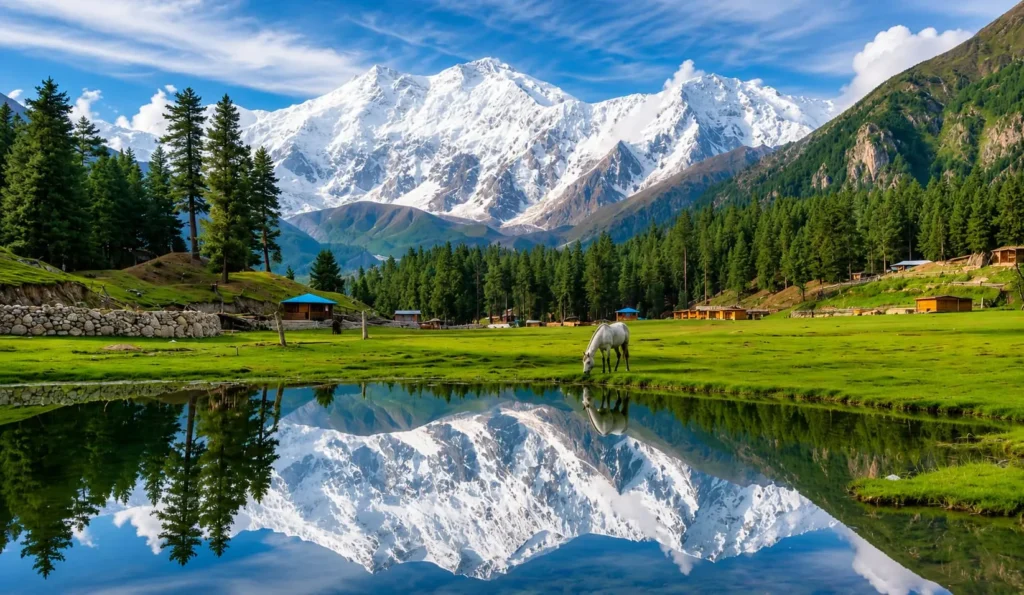
Fairy Meadows is an alpine grassland at roughly 3,300 meters in the Rakhiot Valley, directly below the north face of Nanga Parbat. Locals call it Joot, and it sits inside Nanga Parbat National Park in Diamer District, Gilgit-Baltistan. The meadow is famous for unobstructed views of Nanga Parbat’s 8,126-meter north face, which can be seen directly from a walk-in campsite without a multi-day mountaineering expedition. . Pine forest, the Rakhiot Glacier, and the Raikot stream that feeds the Indus River surround the open meadow. Fairy Meadows functions as the launch point for the Rakhiot face route on Nanga Parbat and for shorter day hikes to Beyal Camp. On clear mornings, climbers, trekkers, and photographers gather at the meadow’s edge to watch sunrise light hit the summit ridge.
How to Reach Fairy Meadows
Reaching Fairy Meadows requires three stages: a long road drive, a jeep transfer on a restricted mountain track, and a foot trek.
From Islamabad to Raikot Bridge
From Islamabad, travelers drive the Karakoram Highway (N-35) through Abbottabad, Mansehra, and Chilas to Raikot Bridge, a distance of roughly 480 to 540 kilometers depending on the route taken. When Babusar Pass is open, usually mid-June through September, that route shortens the Islamabad–Chilas leg but adds altitude exposure above 4,100 meters. When Babusar Pass is closed, the only option is the full Karakoram Highway via Besham and Chilas, which takes 10 to 13 hours from Islamabad in normal traffic. From Lahore, the same route extends to roughly 750 kilometers and 14 to 15 hours of driving, usually split across two days with an overnight stop in Chilas or Naran..
Raikot Bridge to Tattu Village (Jeep Track)
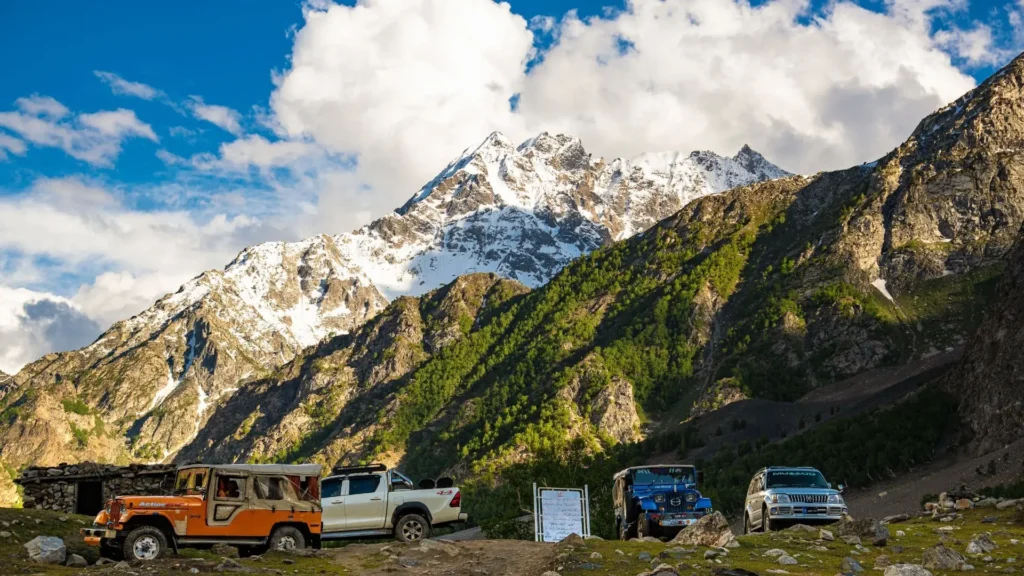
At Raikot Bridge, private vehicles stop; only locally licensed jeep drivers are permitted on the 12 to 15-kilometer track up to Tattu Village, since the road’s steep drops and washouts make it unsuitable for unfamiliar drivers. The jeep ride from Raikot Bridge to Tattu Village takes 1.5 to 2.5 hours depending on recent rain and rockfall.
Tattu Village To Fairy Meadows (The Trek)
From Tattu Village, the trek to Fairy Meadows covers about 5 kilometers and takes 2 to 3 hours on foot through pine forest. Counting the drive, jeep transfer, and trek, most travelers need a full day to reach Fairy Meadows from Chilas, and two days minimum from Islamabad.
Trek Information
Trail Difficulty & Fitness Level
The Tattu Village to Fairy Meadows trek covers approximately 5 kilometers one-way with an elevation gain of around 600 meters. Most hikers complete it in 2 to 3 hours, longer with heavy packs or frequent rest stops. The trail is rated moderate: short enough for a single push, but steep enough at points to challenge unconditioned hikers, especially in the first 30 minutes out of Tattu Village. Beginners with reasonable fitness can complete the trek, particularly if they pace themselves and use trekking poles on the loose-gravel switchbacks. Porters and horses are available at Tattu Village for travelers who prefer not to carry packs or walk the full distance; horse hire typically costs around PKR 2,000 to 3,000 one-way. Beyond Fairy Meadows, the trail continues to Beyal Camp in 45 to 90 minutes of easy walking, and onward to Nanga Parbat Base Camp in another 3 to 5 hours over rougher terrain.
Month-by-Month Guide (January–December)
| Month | Conditions | Road & Trek Access | Travel Notes |
| January | Deep snow at Fairy Meadows; sub-zero nights | Raikot–Tattu jeep track closed | Not recommended; no tourist infrastructure operating |
| February | Heavy snowpack continues | Jeep track closed | Same as January; only used by mountaineering scouting teams |
| March | Snow begins melting at lower elevations near Tattu | Jeep track still largely closed | Karakoram Highway open, but Raikot side track remains unsafe |
| April | Trail patches clear at Tattu Village; upper meadow may still hold snow | Jeep track opens intermittently late in the month | Local operators begin test runs; book only with confirmed road status |
| May | Wildflowers emerging; daytime mild, nights cold | Jeep track generally open by mid-May | Some snow patches possible on the Tattu–Fairy Meadows trail above 3,000m |
| June | Greenery established; Babusar Pass usually opens | Jeep and trek fully open | One of the most reliable months for clear Nanga Parbat views before monsoon haze builds |
| July | Warmest month; afternoon monsoon clouds common | Jeep track open but landslide risk rises after rain | Mornings clearer than afternoons; plan summit-view hikes before 10 a.m. |
| August | Peak monsoon influence from the south; intermittent heavy rain | Jeep track can close for hours or a day after major rainfall | Highest crowd month alongside July; book accommodation well ahead |
| September | Monsoon clears from the Karakoram; skies sharpen | Jeep and trek fully open, among the most stable months | Widely regarded as the best month for photography of Nanga Parbat |
| October | Early autumn color in pine forest; nights drop near freezing | Jeep track typically open through mid-to-late October | First snow possible at higher elevations by month’s end |
| November | First major snowfall usually arrives | Jeep track closes progressively through the month | Most operators stop regular trips by mid-November |
| December | Full winter conditions | Jeep track closed | Fairy Meadows inaccessible to standard tourist transport |
May differs from June mainly in residual snow cover and colder nights, while June offers steadier trail conditions and the start of reliable Nanga Parbat visibility. July and August share monsoon exposure, but August typically sees more sustained rainfall and a higher chance of the Raikot–Tattu jeep track closing for short periods after landslides. September and October both offer clearer skies than the monsoon months, but October adds the risk of an early cold snap and the first dusting of snow on the upper trail. Wildflower season runs roughly from mid-May through July, peaking in June. Snow typically covers the meadow from late November through April, with the heaviest accumulation in January and February.
Weather by Season
Fairy Meadows experiences four distinct weather phases that directly affect visibility, trekking comfort, and road access. Late spring (May–early June) brings daytime highs near 15–18°C and nighttime lows that can drop to 0–4°C, with leftover snow patches above the meadow. Early summer (mid-June–early July) is the most stable window, with daytime temperatures around 18–22°C, clear mornings, and Nanga Parbat typically visible before midday cloud buildup. Monsoon season (late July–August) brings daytime temperatures of 16–20°C but frequent afternoon cloud cover, intermittent rain, and reduced summit visibility on 30–40% of days. Early autumn (September–early October) offers the clearest combination of weather, with daytime highs near 14–18°C, night lows near 2–6°C, and the lowest average cloud cover of the season. Snowfall risk is negligible from June through September but rises sharply after mid-October. Sunrise at Fairy Meadows falls between roughly 5:00 and 5:30 a.m. in June and July, shifting to around 6:00 a.m. by late September; sunset ranges from about 7:30 p.m. in midsummer to 6:15 p.m. in late September. Clothing needs shift with the season: light layers and a fleece for June, a waterproof shell added for July–August, and heavier insulated layers plus a warm hat and gloves for September nights, when temperatures near the meadow can fall close to freezing.
Best Month by Traveler Type
Different travelers should target different windows rather than defaulting to “summer.” Photographers get the most consistent results in September, when post-monsoon skies are clearer and early autumn color appears in the pine forest around Fairy Meadows and Beyal Camp. Families with children benefit most from late June, when the trail is dry, daytime temperatures are comfortable, and the jeep track has been open long enough to be well-graded by local drivers. Serious trekkers aiming for Beyal Camp or Nanga Parbat Base Camp should target mid-June to mid-July, before peak monsoon humidity makes the upper trail slick. Travelers prioritizing solitude should choose early June or mid-September, both of which sit outside the July–August crowd peak while keeping the jeep road and trail fully open. Budget travelers do best in early June or late September, when accommodation rates at Fairy Meadows and Raikot Bridge are lower than the July–August peak-season pricing. First-time visitors with no flexibility on dates should aim for the first half of September, which combines stable road access, lower crowd density, and reliable Nanga Parbat visibility.
Road and Jeep Accessibility by Season
The Raikot Bridge to Tattu Village jeep track is the single biggest accessibility bottleneck for any Fairy Meadows trip. This 12 to 15-kilometer gravel track typically opens in mid-to-late May once winter snow clears from the route and local drivers complete basic grading. It usually closes by mid-to-late November as snow returns to the upper switchbacks, though exact dates shift by two to three weeks depending on that year’s snowfall. After heavy rain, particularly during the July–August monsoon window, sections of the track can wash out or experience rockfall, closing the road for several hours to a full day while local crews clear debris. Landslide risk is highest on the steepest cliffside segments above the Indus River gorge, and drivers will refuse to run the route in active rain regardless of schedule. Private cars cannot reach Tattu Village under any circumstances; only jeeps operated by locally licensed drivers are permitted, a restriction tied to the track’s narrow width and exposed drops. If jeeps stop running due to weather, the backup plan is to wait it out in Raikot Bridge guesthouses or Chilas, since there is no alternate vehicle route to Tattu Village. Travelers with rigid schedules should build at least one buffer day into a Fairy Meadows itinerary to absorb a potential road closure.
Crowds & Costs Calendar
Crowd density and pricing at Fairy Meadows track closely with the jeep road’s open season. July and August see the heaviest crowds, coinciding with summer school holidays in Pakistan, and accommodation at Fairy Meadows and Raikot Bridge often books out days in advance. June and the first half of September see moderate crowds with more room availability. Early May, late September, and October are the quietest windows with the fewest other travelers on the trail. Jeep charges from Raikot Bridge to Tattu Village run roughly PKR 15,000–17,000 for a round trip on a full jeep, shared among passengers, with prices rising slightly during the July–August peak. Wooden cottage accommodation at Fairy Meadows ranges from roughly PKR 4,000–8,000 per night depending on season and room type, while basic camping runs lower. Food at Fairy Meadows is sold at fixed camp-kitchen rates, with a simple meal typically costing PKR 800–1,500, since all supplies are carried up by porter or horse. Guided tour packages from Islamabad that include transport, jeep transfer, and accommodation commonly range from roughly USD 150–350 per person depending on group size, season, and number of nights.
Accommodation
Fairy Meadows offers three accommodation types: wooden cottages, basic hotel-style lodges, and camping. Wooden cottages, built in the traditional Gilgit-Baltistan style, are the most common option and range from simple shared rooms to slightly more private units with attached bathrooms. A handful of small hotels near the meadow and at Raikot Serai offer similar rustic rooms with shared facilities. Camping is available for travelers who bring or rent tents, with commonly used camping areas near the main Fairy Meadows clearing and along the approach to Beyal Camp. . None of these options include reliable electricity beyond a few hours of generator power in the evening, and heating is limited to wood stoves. Advance booking is strongly advised for July and August, when rooms at Fairy Meadows and at the Raikot Bridge staging point fill quickly; outside peak season, walk-in availability is more common but not guaranteed during holiday weekends.Generator power at most Fairy Meadows guesthouses typically operates only for a few evening hours, so charge cameras, phones, and power banks immediately after arrival.
Things to Do
The primary activity at Fairy Meadows is taking in direct views of Nanga Parbat’s north face from the open meadow, best at sunrise before cloud buildup. A 45 to 90-minute hike leads to Beyal Camp, a quieter clearing with closer mountain views and a basic tea stop. From Beyal Camp, the trail continues 3 to 5 hours to Nanga Parbat Base Camp, the most demanding day hike from Fairy Meadows. Photography is a major draw, with the Reflection Pond near the meadow and the ridge above Beyal Camp serving as the most reliable vantage points. At night, low light pollution at 3,300 meters makes Fairy Meadows a strong stargazing location, with the Milky Way visible to the naked eye on clear nights. Bonfire gatherings are common at the main camping area in the evening, organized by local guesthouse staff for overnight guests.
Packing List by Season
Packing needs shift meaningfully between the May–June window, the July–August monsoon, and the September–October shoulder season. For May and June, pack a mid-weight fleece, a light insulated jacket for cold nights, sturdy trekking shoes with ankle support, and a light rain layer for occasional afternoon showers. For July and August, prioritize a full waterproof rain jacket and pack cover, quick-dry clothing layers, and trekking shoes with good grip for muddy sections of the trail. For September and October, add a heavier insulated jacket, gloves, and a warm hat, since night temperatures near the meadow can approach freezing. Across all seasons, carry basic medicines including altitude-sickness tablets, rehydration salts, and personal prescriptions, since Fairy Meadows has no pharmacy or clinic. A power bank is essential, as electricity is limited to a few generator hours per evening. Trekking poles help on the steep initial climb out of Tattu Village in any month.
Sample 3-Day Itinerary
A three-day Fairy Meadows itinerary is suitable for most travelers because it allows enough time for the drive from Islamabad, the jeep transfer from Raikot Bridge to Tattu Village, one overnight stay at Fairy Meadows, and a sunrise hike. Day 1 covers the drive from Islamabad to Chilas via the Karakoram Highway. Day 2 includes the jeep ride to Tattu Village, the 5-kilometer trek to Fairy Meadows, and sunset views of Nanga Parbat. Day 3 begins with sunrise, continues to Beyal Camp if time allows, and finishes with the return to Raikot Bridge. Travelers planning the Nanga Parbat Base Camp trek should allow at least one additional day.
Travel Tips
Carry sufficient cash before reaching Raikot Bridge, since there are no ATMs or card payment options anywhere past Chilas. Mobile network coverage from providers like Zong and SCOM is limited and often unreliable at Fairy Meadows and nonexistent along parts of the Tattu trail. Prepare for sudden weather shifts between Raikot Bridge, Tattu Village, and Fairy Meadows, where clear June mornings often give way to afternoon cloud or light rain . Build basic fitness before the trip, since the steep first 30 minutes out of Tattu Village is the most physically demanding stretch of the entire trek. Foreign travelers should register at the police checkpoint in Chilas and carry photocopies of their passport and visa, a standard requirement in Diamer District.Local jeep drivers usually recommend leaving Raikot Bridge before 8:00 a.m. during summer because afternoon cloud, rain, and traffic delays become more common later in the day.
FAQs
What is the best month to visit Fairy Meadows?
September is the best month to visit Fairy Meadows because it usually offers the clearest views of Nanga Parbat, comfortable trekking weather, and fewer visitors than peak summer. The jeep road from Raikot Bridge to Tattu Village is normally still open, and trails are generally dry. Pack warm layers because temperatures drop sharply after sunset at 3,300 meters.
Is Fairy Meadows open all year?
No, Fairy Meadows is not open all year because heavy winter snowfall usually closes the jeep road between Raikot Bridge and Tattu Village. Most travelers visit from late May to early October, although exact opening and closing dates depend on snowfall and road conditions. Check the latest road status before leaving Islamabad or Gilgit.
When does the jeep road to Fairy Meadows open?
The jeep road to Fairy Meadows usually opens between late May and early June after winter snow is cleared from the Raikot Bridge–Tattu Village route. Opening dates vary each year because snowfall and landslides affect maintenance work. Confirm road conditions before starting your journey along the Karakoram Highway.
Can I visit Fairy Meadows in October?
Yes, you can often visit Fairy Meadows in early October while the jeep road remains open and before heavy snowfall begins. Autumn colors and clearer post-monsoon skies make October a favorite month for photography. Cold nights and the possibility of early snow mean carrying insulated clothing is essential.
Can I visit Fairy Meadows in winter?
No, winter is generally not a practical time to visit Fairy Meadows because snow usually blocks vehicle access beyond Raikot Bridge. Guesthouses and camps are largely closed, and trekking becomes hazardous due to snow and ice. Most visitors should plan their trip between late May and early October.
How cold does Fairy Meadows get at night?
Summer nights at Fairy Meadows commonly fall to around 0°C to 5°C, while September and October nights often drop below freezing. The high elevation of approximately 3,300 meters makes evenings feel colder than valley temperatures. Carry thermal clothing, a warm jacket, gloves, and a suitable sleeping bag if camping.
How difficult is the trek to Fairy Meadows?
The trek to Fairy Meadows is moderately difficult, covering about 5 kilometers from Tattu Village and taking around 2–3 hours on foot. The uphill trail includes rocky and uneven sections but requires no technical climbing experience. Wear trekking boots and carry enough drinking water for the ascent.
Can beginners complete the Fairy Meadows trek?
Yes, beginners with reasonable fitness can complete the Fairy Meadows trek by maintaining a steady pace and taking regular breaks. Horses are usually available for hire at Tattu Village for travelers who need assistance on the climb. Starting early in the morning helps avoid afternoon heat and changing mountain weather.
How many days are enough for Fairy Meadows?
Two nights are enough for most travelers because they allow time to enjoy Fairy Meadows, hike to Beyal Camp, and experience sunrise views of Nanga Parbat. A four- to five-day itinerary from Islamabad gives enough time for travel and sightseeing. Adding an extra day provides flexibility if weather delays the journey.
Is Fairy Meadows better than Hunza?
Fairy Meadows is better for trekking and close-up views of Nanga Parbat, while Hunza is better for road trips, cultural sites, and easier sightseeing. Fairy Meadows requires a jeep ride and a 5-kilometer hike, whereas most Hunza attractions are accessible by road. Many travelers include both destinations in one northern Pakistan itinerary.
What should I wear for Fairy Meadows in September?
Wear layered clothing in September, including thermal wear, a fleece, a waterproof jacket, trekking trousers, and sturdy hiking boots. Morning and nighttime temperatures can approach or fall below freezing despite pleasant daytime conditions. Pack gloves and a warm hat if you plan to watch sunrise over Nanga Parbat.
Is Fairy Meadows worth visiting during the monsoon season?
Yes, Fairy Meadows can still be worth visiting during July and August, but rain, cloud cover, and occasional landslides along the Karakoram Highway are more likely. Early mornings often provide the best chance for clear views of Nanga Parbat before afternoon clouds develop. Keep one extra day in your itinerary in case weather affects road access.
Plan your Fairy Meadows trip with Northern Discover — WhatsApp us at +923419674740 or email northerndiscover.pk@gmail.com